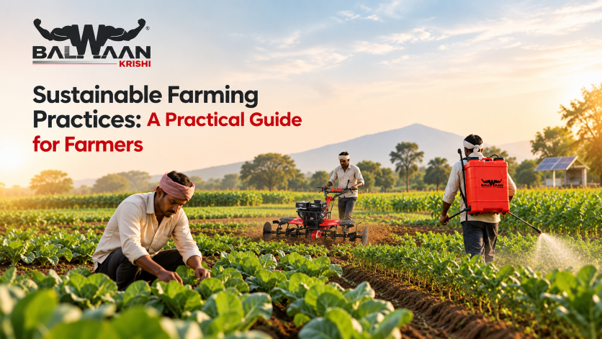
Farmers who get consistent results tend to share a few habits. They work with the soil instead of against it, use water carefully, and get fieldwork done on time rather than late. None of this requires a bigger budget for inputs.
This guide covers practical tips for farming under Indian conditions, from soil preparation and crop selection through irrigation, mechanisation, and post-harvest handling. It will help you understand what to focus on at each stage of farming, avoid common mistakes, and choose practical methods that can improve productivity without adding unnecessary costs.
What Makes Farming Successful? Understanding the Basics
Successful agriculture depends on four connected factors:
1. Healthy living soil
2. Matching crops to regional climate
3. Precise water use
4. Timely field operations through mechanisation.
When any one of these fails, yield drops regardless of how much fertiliser or seed gets applied.
Balanced fertiliser use, for instance, does little good if the soil pH prevents root uptake, or if delayed weeding lets wild grasses take up moisture before the crop establishes. Treating the farm as one connected system helps a farmer put resources where they actually move output.
Essential Tips for Farming Every Farmer Should Know
Foundational farm practices stay largely the same across regions and crops. These are worth mastering before adopting more complex technology.
1. Test and Improve Soil Health First
Healthy soil produces resilient crops. A proper soil test reveals exact macro-nutrient levels (nitrogen, phosphorus, potassium), secondary nutrients (sulphur, calcium, magnesium), micronutrients (zinc, boron, iron), and pH balance. Sowing without a soil test often leads to over-applying urea while ignoring a real zinc or boron deficiency underneath.
A review of India's Soil Health Card scheme, which has issued free soil test cards to roughly 11 crore farmers nationwide, found that following the scheme's recommendations raised crop yields by 5 to 6% while cutting chemical fertiliser use by 8 to 10%.
Once the test report comes back, a few corrections usually follow:
- Correct soil pH
Apply agricultural lime to acidic soils or gypsum to alkaline soils, as advised by the local extension centre.
- Restore organic matter
Work well-decomposed farmyard manure or vermicompost into the soil at 5 to 10 tonnes per hectare before field preparation.
- Add bio-fertilisers
Treat seeds or root zones with Rhizobium for pulses, and Azotobacter or phosphate-solubilising bacteria for cereals, to make nutrients already in the soil available to the plant.
- Grow a green manure crop
Sunn hemp or dhaincha, turned under before the main planting, restores organic nitrogen to the soil.
2. Choose Crops Suited to Your Land and Climate
Matching crop choice to local soil and climate lowers input costs and cuts the risk of total crop failure. A high-water crop planted in a semi-arid zone drains groundwater fast and ends up needing expensive emergency irrigation.
- Heavy clay soils hold moisture well, which suits cotton, soybean, and wheat.
- Sandy loam drains quickly instead, which works better for groundnut, tubers, maize, and vegetables.
- Cooler North Indian winters suit wheat, mustard, and chickpea.
- High-rainfall regions suit paddy and sugarcane.
- Rainfed areas hold up better with millets like bajra, jowar, and ragi through longer dry spells.
For sowing whichever crop fits, Balwaan's S-12H manual seeder for crop sowing places seed through 12 adjustable mouths at a set depth and spacing, giving seed the even soil contact it needs to germinate well.
3. Practice Smart Water Management
Flood irrigation loses a significant share of applied water to runoff and deep percolation, and it also encourages root rot and weed growth in standing water. Switching to a more water-efficient system keeps moisture more even across the root zone instead.
- Drip irrigation
Delivers water and water-soluble nutrients straight to the root zone, cutting the water lost to runoff and evaporation that flood irrigation suffers, while also reducing weed pressure between rows since less water reaches the open soil between plants.
- Micro-sprinklers
Micro-sprinklers suit close-growing crops like groundnut, garlic, onion, and pulses well, creating a slightly cooler microclimate that eases heat stress.
- Mulching
Mulching is covering the soil surface around a crop with a protective layer, whether organic residue or plastic film. This stops surface evaporation, prevents the topsoil from crusting, and slows weed germination underneath it.
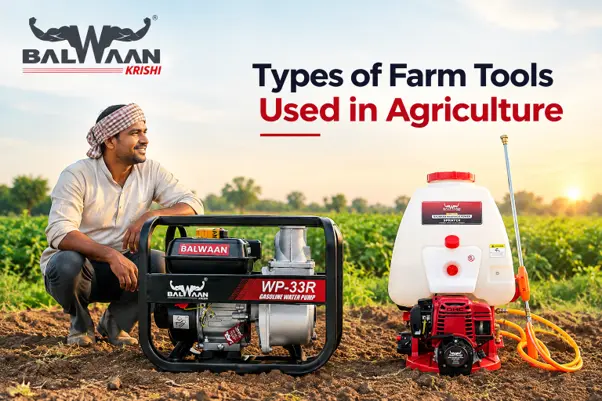
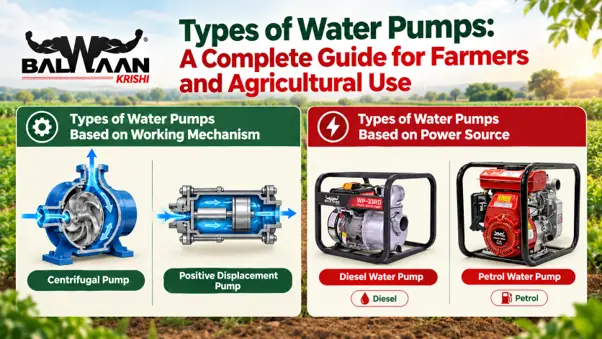
For running a drip or sprinkler setup without relying on grid power, Balwaan's WP-15R water pump for farm irrigation keeps water pressure steady during a dry stretch, weighing light enough at around 11 kilograms for one person to move between fields.
4. Follow Crop Rotation and Diversification
Growing the same crop continuously exhausts specific nutrients in that root zone and lets crop-specific pests and soil-borne disease build up season after season.
- Nutrient rotation
Rotating a heavy-feeding cereal like maize or wheat with a deep-rooted legume, such as pigeon pea, chickpea, or green gram, lets the legume fix nitrogen back into the soil naturally.
- Breaking pest cycles
Switching between plant families entirely, say from a tomato or brinjal crop to a cereal or leafy brassica, breaks the life cycle of pests and fungal spores specific to one family.
- Income diversification
Setting aside a portion of the farm for horticulture, fodder, or dairy protects household income against a bad season for the main crop.
Modern Farming Techniques That Improve Efficiency
Modern farming techniques let a grower finish intensive tasks faster, manage inputs more precisely, and protect margins even as weather becomes less predictable.
1. Mechanising Key Farm Tasks Like Weeding, Cutting, and Spraying
Manual field work is slow and physically exhausting, and hard to organise when local labour is scarce. Hand-weeding a full hectare often takes several workers multiple days, and every one of those days lets weeds pull light and fertiliser away from the main crop.
- Weeding between rows:
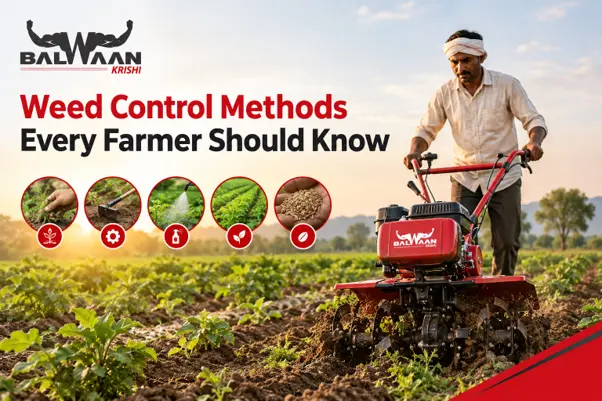
Balwaan's BP-750E, a power weeder for farming, lets a single operator weed and aerate the soil between crop rows in hours instead of days, pulling weeds out while opening the soil for air to reach the root zone.
- Clearing boundaries:
Boundary weeds, thick grass, and fodder along a bund or canal are a separate job that a sickle handles slowly. Balwaan's BX-35B, a backpack brush cutter, carries its 35cc engine on a knapsack harness and cuts growth up to 255mm thick.
- Spraying at the right moment
A knapsack sprayer's manual pumping action makes coverage uneven just when consistency matters most. Balwaan's BS-30GL battery sprayer for crop protection runs a lithium-ion battery through a double motor at up to 130 PSI, holding steady pressure that reaches the underside of leaves where insects hide.
2. Using Data and Technology for Better Farm Decisions
A few digital tools remove guesswork from routine field decisions.
- Weather advisory apps track hyper-local rain forecasts, which helps avoid spraying chemicals right before a downpour washes the treatment away.
- Soil moisture sensors and tensiometers show directly whether a field actually needs irrigation, instead of watering on a fixed schedule regardless of real soil condition.
- Digital mandi price portals track real-time commodity prices at nearby markets, showing where selling the harvest will actually pay the most.
3. Adopting Integrated Pest Management (IPM)
Integrated Pest Management combines biological, mechanical, and cultural controls, keeping synthetic spray as a last resort rather than a first response. This protects beneficial insects, slows pesticide resistance building up, and keeps chemical residue off the harvested crop.
- Install monitoring traps
Yellow sticky traps catch whiteflies and aphids; pheromone traps catch bollworms and borers before numbers build up.
- Bring in biological control
Beneficial predators like Chrysoperla lacewings, ladybird beetles, or Trichoderma fungal treatments work early in the season, before pest numbers cross a damaging threshold.
- Try a botanical spray first
Neem seed kernel extract or neem oil handles early insect activity in many cases, keeping a chemical spray in reserve for when pest numbers actually cross the economic threshold.
How to Improve Crop Yield with the Right Farm Equipment
A large share of yield loss traces back to field operations finishing too late rather than anything wrong with the crop itself. Weeds left in a field for an extra week keep drawing down the nutrients meant for the crop. A crop harvested past its prime dries out, shatters, or spoils if rain arrives at the wrong moment.
Matching Equipment to Farm Size and Crop Type
Equipment needs to fit the planting layout, soil, and total acreage, not just the job on paper. A smallholding with tight turnarounds and narrow row spacing usually does better with compact, multi-purpose machinery that a heavy four-wheel tractor simply can't manoeuvre through without damaging the crop.
Broadacre cereal crops like paddy, wheat, and oats need fast, low-loss cutting right at maturity. Balwaan's PR-900, a walk-behind power reaper for crop harvesting, runs a 5HP diesel engine that cuts and lays rows of mature crop cleanly in a fraction of the time manual sickle cutting takes, avoiding the shattering losses that come with a delayed manual harvest.
Reducing Labour Dependency with Powered Tools
Farm wages rise, and workers grow scarce right during peak sowing, weeding, and harvesting windows, and hand tools alone often leave these jobs half-finished when that happens. Switching to powered tools for the most labour-heavy tasks keeps critical work on schedule regardless of local labour shortages, protecting the yield a whole season went into producing.
Farming Best Practices for Post-Harvest Handling and Storage
Careless handling after harvest can undo months of careful field work. A few farming best practices prevent most of the weight loss, mould, and insect damage that shows up in storage.
- Harvest at the right moisture content
Harvest cereals once grain moisture drops to around 18 to 20 percent. Too early causes shrivelled grain; too late risks field shattering and bird damage.
- Clean and grade on the threshing floor
Separate out dust, chaff, weed seed, and broken grain immediately, since broken seed skins are what invite weevils and beetles into storage.
- Dry grain gradually
Sun-dry cereals on a clean tarpaulin until moisture drops below 10 to 12% before bagging. Oilseeds and pulses need drying down further, to around 8 to 9%.
- Store properly
Keep dry grain off a concrete floor on wooden pallets, with bags at least 50 centimetres from the wall. Hermetic bags or well-sealed metal bins keep out moisture, rodents, and storage pests.
Common Mistakes That Reduce Farm Productivity
A handful of routine errors account for most of the avoidable yield loss on Indian farms.
- Over-irrigating
Excess water drowns root systems, cuts off oxygen, leaches nitrates below the root zone, and invites root rot fungi like Phytophthora and Pythium.
- Delaying the first weeding
Weeds do most of their damage in the first 20 to 45 days of crop growth, and weeding late can't recover the vegetative growth already lost.
- Ignoring the soil test report
Fertilising by habit instead of by test result leads to imbalances, like excess nitrogen causing lodging, overly soft growth, and higher pest vulnerability.
- Skipping routine equipment maintenance
Forgetting to clean an air filter, sharpen a blade, or drain fuel from a sprayer or tiller usually shows up as a breakdown in the middle of field work.
- Blanket chemical spraying
Spraying broad-spectrum insecticide on sight kills natural predators like spiders and hoverflies too, which often triggers a secondary pest outbreak once they're gone.
None of these mistakes need expensive fixes, just attention at the right moment in the season. Working these efficient farming methods into the regular routine is usually enough to protect a season's yield on its own.
FAQs - Frequently Asked Questions
How often should soil testing be done?
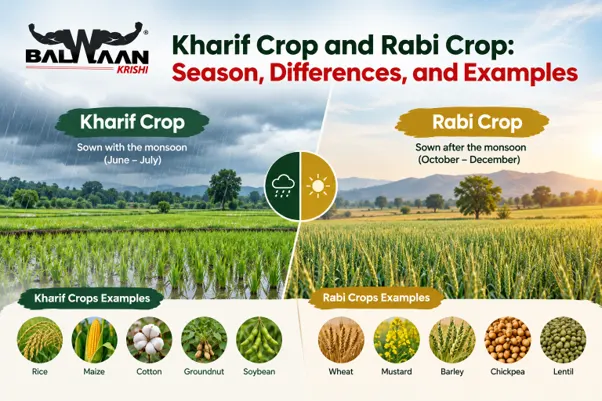
Soil testing works best once every two to three years, done at the same time of year, ideally during the summer fallow after the rabi harvest and before kharif sowing begins.
Is mechanisation useful for small and marginal farmers?
Mechanisation is genuinely useful for small and marginal farmers, provided the equipment is sized right. Lightweight and battery-powered tools, manual seeders, compact power weeders, backpack brush cutters, are built with small plots specifically in mind, cutting labour cost and keeping sowing and weeding on schedule.
What is the role of crop rotation in improving soil health?
Crop rotation improves soil health in three ways at once: it breaks the disease cycle tied to a single crop, prevents one root zone from being drained of the same nutrient repeatedly, and adds nitrogen back naturally whenever a cereal is followed by a deep-rooted legume.
How does Integrated Pest Management differ from regular pesticide use?
Regular spraying applies chemical pesticides on a schedule, whether pests are actually present or not. Integrated Pest Management relies on cultural practices, physical barriers, traps, and biological controls first, turning to a targeted chemical only once pest numbers cross an economic threshold.
How can farmers reduce post-harvest losses?
Reducing post-harvest losses means harvesting at physiological maturity, drying grain down to a safe storage moisture (under 12% for cereals), cleaning out foreign matter before bagging, and storing in hermetic bags or sealed bins kept off the bare ground.