Choosing the wrong water pump costs an Indian farm real money: wasted diesel, a burnt-out motor, or a borewell that won't give up water fast enough. A dependable pump handles irrigation, field drainage, and moving water in bulk from a borewell, a farm pond, or a shared canal, and getting that choice right affects both crop yield and running cost for years afterward. Modern equipment brands like Balwaan Krishi provide heavy-duty water pumps built to withstand challenging rural field conditions.
This guide breaks down the main types of water pumps, explains how their mechanics and power sources work, and walks you through how to choose the right pump for your farm.
What Is a Water Pump and How Does It Work in Farming?
A water pump moves water from wherever it naturally sits, like a borewell, pond, or canal, onto the land you're actually growing on. It does this by turning electrical energy, engine power, or solar energy into pressure to push water through a pipe.
That pressure has to overcome gravity, suction resistance, and friction inside the pipe itself. Once it does, water reaches the field through open channels, buried pipes, drip lines, or overhead sprinklers, whichever the irrigation setup uses.
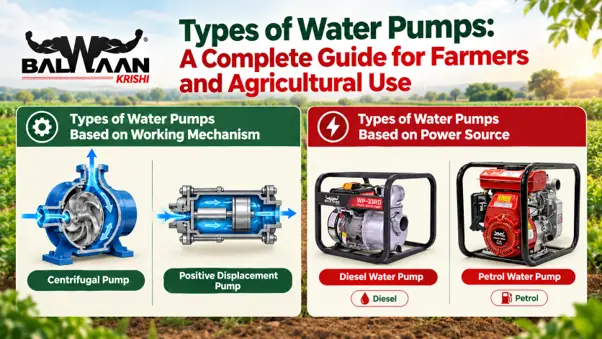
Types of Water Pumps Based on Working Mechanism
Agricultural water pumps are usually classified by the physical method they use to move fluid.
1. Centrifugal Pumps
Centrifugal pumps are by far the most common pump on Indian farms. Inside the casing sits an impeller, a rotating disc that spins fast enough to push water outward using centrifugal force. That spinning motion turns into steady pressure at the outlet, pulling more water in continuously through the intake.
Centrifugal units are valued for their mechanical simplicity, high discharge volume, and steady delivery across general open-field irrigation.
2. Positive Displacement Pumps
Positive displacement pumps take a different approach entirely. Instead of flinging water outward, they trap a fixed amount inside a chamber and physically force it out, using a piston, a diaphragm, or a set of rotating gears depending on the design.
Because output remains steady regardless of discharge pressure, these units are well suited to moving water containing suspended silt, mud, and light debris. They also work well for dosing farm chemicals or applying liquid fertilizers directly into irrigation lines.
Types of Water Pumps Based on Power Source
Power availability is usually the first consideration for Indian farmers when selecting field equipment: diesel and petrol engines run off-grid, while electric and solar options suit a farm with a stable connection or reliable sunlight.
1. Diesel Water Pump
A Diesel Water Pump is the standard choice for heavy-duty irrigation in areas with erratic or non-existent electrical grid power. For instance, the Balwaan WP-33RD runs a heavier-duty engine built for long, continuous pumping sessions, well suited to deep borewells, rivers, or large reservoir canals where the pump needs to run for hours without a break. The initial equipment cost is higher than petrol alternatives, but diesel's fuel efficiency delivers a lower cost per litre pumped during long irrigation runs.
2. Petrol Water Pump
A Petrol Water Pump offers high portability and an easy pull-start. The Balwaan WP-15R (a petrol water pump) weighs about 11 kilograms, light enough for one worker to carry across bunds and muddy fields without help. These compact, engine-driven units suit small-to-medium land holdings, nursery beds, orchard spray work, and intermittent water transfer.
3. Electric Water Pump
Electric pumps deliver high operating efficiency wherever farms have access to a reliable, three-phase power grid. These motors run quietly, produce no direct field emissions, and need minimal daily maintenance, since they have no fuel filters, carburetors, or engine oil reservoirs to look after.
4. Solar Water Pump
Solar-powered pumps use photovoltaic panels to run a DC or AC pump motor. They give growers an eco-friendly, off-grid option that avoids diesel price increases and rural grid outages altogether. Upfront capital cost is high, but zero recurring fuel cost makes them cost-effective in regions with reliable, year-round sunlight.
The PM-KUSUM scheme, run by the Ministry of New and Renewable Energy, covers a central subsidy of at least 30% of a solar pump's cost for individual farmers, rising to 50% in North Eastern and hill states, which brings that upfront cost down considerably for anyone who qualifies.
Types of Irrigation Pumps Used in Agriculture
Matching the pump to your specific field layout and water source ensures proper pressure delivery without wasting energy.
The table below breaks down the four main categories by typical water source, best use case, and pressure character, so you can find the right match quickly before reading the details on each one.
Submersible and monoblock pumps are the two categories most farms actually choose between day to day, so they're covered in more depth below.
Submersible Pumps for Borewell Irrigation
Submersible pumps have an airtight, sealed motor coupled directly to the pump body. The entire assembly is lowered deep inside a drilled borewell casing, operating fully submerged underwater.
Because they push water upward rather than pulling it from above ground, they aren't limited by atmospheric suction. This makes submersibles the standard choice for farms across northern and peninsular India that rely on deep groundwater aquifers.
Monoblock and Self-Priming Pumps for Surface Water
Monoblock pumps mount the motor and pump impeller on a single shared shaft, cutting mechanical friction losses. Paired with a self-priming chamber, they clear air pockets from the intake line automatically during startup.
These work well on surface-level reservoirs, village ponds, check-dams, and lined canals where total suction depth stays within 15 to 25 feet. For silty or debris-laden canal water, a specialised Trash Water Pump is the better fit. Balwaan WP-33T (trash water pump) has a wider 2.89-inch suction and delivery size, built to pass silt and debris through without clogging the way a standard pump would.
High Pressure Water Pumps for Agricultural Use
A high-pressure water pump provides the force needed to move water across steep ground or through pressurised irrigation hardware. This is why Balwaan offers this feature in its WP-22N, built for higher-pressure delivery where a standard pump's output isn't enough.
Standard open-discharge pumps move a high volume of water at low pressure, which suits traditional flat furrow flooding. High-pressure pumps instead use tight internal tolerances and multi-stage impellers to deliver water at high bar or PSI ratings.
You need a high-pressure pump in three situations:
- Running impact sprinklers, overhead micro-sprinklers, or high-throw rain guns, since these need internal nozzle backpressure to atomise the spray.
- Sending water through delivery pipelines that run several hundred metres from source to field.
- Lifting water from a valley floor up to hillside terraces or orchards.
How to Choose the Right Water Pump
Choosing the right pump comes down to a handful of practical checks, worked through in order. Skipping any one of them is how a farm ends up with a pump that can't reach its water, or one that's the wrong size for the job.
1. Water Source and Depth
Start by measuring your actual water depth rather than estimating it. If your water source sits deeper than 25 feet below ground level, a surface pump cannot pull the water up, since surface pumps are limited by atmospheric suction. You need a submersible pump instead. For open ponds, streams, or dug wells shallower than 20 feet, a surface centrifugal or engine-driven pump works reliably.
2. Calculating Total Dynamic Head
Once you know your water depth, add up the total dynamic head: the vertical lift, any change in discharge elevation, and pipe friction losses along the way. This figure tells you how much pressure the pump actually has to produce, not just how far down the water sits.
3. Field Size and Flow Rate Needed
Work out how much water your field needs, based on crop acreage, how quickly your soil absorbs water, and how often you irrigate. Pump capacity is measured in Litres Per Minute (LPM) or cubic metres per hour. A pump that's too small means longer pumping hours and crop stress during a heatwave. A pump that's too large washes out topsoil and wastes power.
4. Power Availability
Look honestly at what power your farm actually has. If your area gets frequent three-phase power cuts or voltage swings, a diesel or petrol engine-driven pump keeps you independent of the grid. If your farm has a steady electrical connection, an electric monoblock pump gives you quiet, push-button operation instead.
5. Fuel Efficiency and Running Cost
The running cost of a pump adds up to more than its purchase price over time. Work out fuel consumption per hour against current diesel or petrol prices, then multiply that across your expected watering calendar for the season. For four to eight hours of continuous daily pumping, a fuel-efficient diesel engine typically costs less over a season than a petrol one.
6. Maintenance and Durability
Think about how much technical skill the pump's upkeep actually needs. Fuel-powered engines need regular oil changes, spark plug or fuel injector cleaning, and air filter maintenance. Electric and submersible pumps need less day-to-day attention, but a repair usually means calling a certified technician or pulling the unit out of the borewell. Choose a cast-iron or treated aluminium pump casing to resist rust from hard, mineral-heavy groundwater.
Common Mistakes Farmers Make While Selecting a Water Pump
A few recurring errors account for most pump problems farmers run into after purchase:
- Oversizing the motor
Buying more horsepower than needed creates high discharge velocity that blows out drip emitters, damages pipelines, and burns surplus fuel.
- Ignoring total suction limits
Surface pumps cannot lift water higher than 22 to 25 vertical feet at sea level. Going past this limit causes cavitation, which pits the impeller and ruins internal seals.
- Mismatching pump output with well yield
Running a high-discharge pump inside a low-recovery borewell pulls air into the suction stage, running the pump dry and overheating internal bearings.
- Overlooking seasonal maintenance
Storing fuel-driven pumps over the monsoon with stale fuel in the carburetor degrades rubber gaskets and causes starting problems right when irrigation season resumes.
Frequently Asked Questions
Which type of water pump is best for agriculture?
The best pump depends on your water source and power supply. For deep borewells, a multi-stage submersible pump is the right choice. For open rivers, canals, or farm ponds, an engine-driven centrifugal pump or self-priming monoblock pump gives dependable, high-volume water transfer.
What is the difference between a diesel and petrol water pump?
Diesel pumps give higher torque and better fuel efficiency for long, heavy-duty pumping jobs, but come with a heavier frame and a higher purchase cost. Petrol pumps are lighter, cost less upfront, and start easily, which suits portable jobs on smaller acreage.
How much pressure does an irrigation water pump need?
Open furrow and flood irrigation need minimal pressure, around 1 to 2 bar, focused mainly on water volume. Micro-drip systems need steady pressure between 1.5 and 2.5 bar, while large agricultural rain guns need 3 to 5 bar to distribute water evenly.
Can a centrifugal pump be used for borewell irrigation?
A standard surface centrifugal pump can only draw water from a shallow borewell, where the dynamic water level stays within 20 to 25 feet of the surface. For a deeper borewell, use a submersible centrifugal pump positioned directly inside the well casing, below the water line.
How do I calculate the right pump capacity for my field?
Multiply your total cropped area by your crop's peak daily water requirement in millimetres to get the total litres needed per day. Divide that by your target daily pumping hours to find the Litres Per Minute (LPM) rating your pump needs.