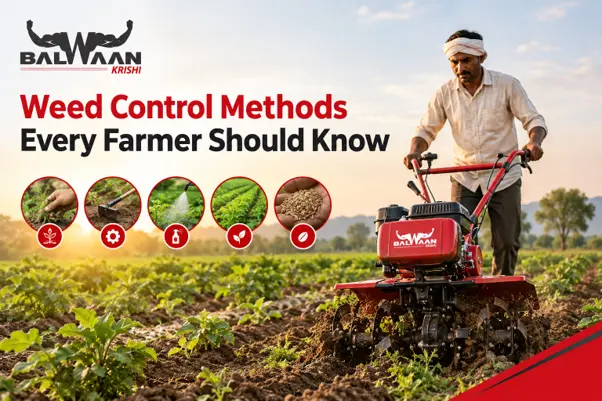
Weeds compete with crops for essential resources such as soil moisture, nutrients, sunlight, and space to grow. If left unchecked, they can slow crop growth, reduce yields, and affect harvest quality. Farmers can manage weeds through several methods, including preventive practices, crop rotation, mulching, mechanical weeding, herbicide application, and biological control. The right combination depends on the crop, soil conditions, weed growth, and stage of cultivation. Understanding these methods helps farmers choose practical ways to control weeds and protect their harvest.
Why Weed Control Matters in Agriculture
Weed control in agriculture matters for reasons that go beyond the obvious competition for water and nutrients.
A 2025 ICAR and FSII report found weeds cause 25 to 26% yield loss in kharif crops and 18 to 25% in rabi crops across India. Nationwide, that adds up to an estimated ₹92,000 crore in lost crop value every year.
The damage isn't only about the yield number, though. Broadleaf and tall grass weeds shade shorter, slower-growing crops like vegetables, cotton, and pulses. That shade cuts into how much light actually reaches the crop's own leaves.
Weeds left standing along beds and furrows also give pests somewhere to live between crop cycles. Aphids, whiteflies, and various fungal and viral diseases all use weeds as a host in between seasons.
Even weed seed mixed into harvested grain or pulses causes damage on its own. It lowers the market grade, which shows up as a lower price at the mandi rather than a lower yield on paper.
Types of Weed Control Methods
Agricultural science groups weed management into five categories: preventive, cultural, mechanical, chemical, and biological. Each one works differently, and the sections below cover what each involves.
Preventive Weed Control
Preventive weed control stops weed seed from entering a field in the first place, instead of dealing with it once it's already growing.
- Sowing certified, weed-free seed avoids introducing a new weed species into land that hasn't had it before.
- Cleaning tractor implements, tillers, and harvesters before moving from an infested field to a clean one stops seed from hitching a ride between plots.
- Screening irrigation water through mesh at the channel or pond intake catches floating seed before it spreads.
- Fresh, undecomposed manure often carries live weed seed straight through an animal's digestion, so composting it fully first matters.
Cultural Weed Control
Cultural weed control changes how a field is managed so the crop itself out-competes weeds for space and light.
- Rotating deep-rooted and shallow-rooted crops disrupts the growth cycle any single weed species settles into.
- Closer plant spacing closes the crop canopy earlier, shading the soil surface before weed seedlings get much light.
- Mulch, whether crop residue or plastic sheeting, blocks light from reaching buried weed seed directly.
- Placing fertiliser close to the crop's own root zone, instead of broadcasting it across the whole bed, feeds the crop without also feeding the weeds between rows.
Mechanical Weed Control
Mechanical weed control uses physical tools and machinery, from a hand hoe to a powered weeder, to cut, uproot, or bury weeds directly.
- No costly herbicide is needed, which keeps the input cost down.
- No chemical residue builds up in the soil over time.
- The tool works the soil itself in the process, helping with aeration too.
This is a central method in Indian farming for exactly these reasons. The next section goes into it in more depth, since it's where most of the equipment choices actually happen.
Chemical Weed Control
Chemical weed control uses herbicides to kill or suppress a targeted weed population.
- Pre-emergent herbicides go onto moist soil right after planting, stopping weed seed from germinating before it breaks the surface.
- Post-emergent herbicides target weeds already growing instead, applied at a specific leaf stage.
Getting the sprayer calibration, dosage, and label instructions right matters as much as the chemical choice itself. An overdose risks burning the crop and leaving residue into the next season.
Biological Weed Control
Biological weed control uses living organisms instead of machinery or chemicals to keep weeds down.
- Fast-growing smother crops like cowpea or sunn hemp out-compete weeds directly through sheer growth speed.
- Controlled grazing after harvest clears stubborn perennial grass and leftover residue.
- A specific insect, like the Zygogramma bicolorata beetle used against Parthenium, can be introduced to feed on one invasive weed without touching the main crop.
Mechanical Weed Control Methods and Tools
Mechanical weed control gives fast, visible results across most soil types and cropping patterns, and the right implement depends mainly on row spacing, soil moisture, and how dense the weed growth already is.
1. Hand Weeding and Hoeing
A hand tool like the khurpi or hoe still does the most precise job around delicate vegetable stems or in a tight nursery bed, since nothing mechanical works quite that close without risking the crop. The trade-off is labour: hand weeding takes far more time and physical effort than a powered tool, which makes it hard to justify across more than a small plot.
2. Power Weeders for Field-Scale Weeding
A power weeder mechanises inter-row weeding across wider row crops like sugarcane, cotton, maize, and orchards, cutting weed roots and breaking crusted soil in a fraction of the time hand hoeing takes. Balwaan's BP-700, sold as a power weeder for weed control, runs a petrol engine driving curved tines through the soil, built for exactly this kind of repeated inter-row pass.
3. Brush Cutters for Clearing Overgrown Areas
Drainage channels, bunds, and tree basins often grow thick with weeds a walk-behind machine can't reach or navigate around. Balwaan's BX-52 brush cutter for weed control cuts growth up to 255mm thick, clearing woody stalks and thickets that a power weeder isn't built to handle.
4. Tillage and Inter-Row Cultivation
Deep tillage with a mouldboard or disc plough before sowing exposes buried weed roots and dormant tubers to direct summer sun, drying them out before they get a chance to sprout. Once the crop is up, an inter-cultivator does a lighter version of the same job between the rows, cutting weed growth and loosening the topsoil so water reaches the crop's own roots more easily. Balwaan's FR-180, an inter-cultivator for weed control, covers this job through the growing season.
Digging holes near field borders, for a fence post or a new sapling, is a separate task the tools above don't cover well. Balwaan's manual earth auger handles that job cleanly instead, without disturbing the surrounding soil the way digging by hand would.
How to Control Weeds in Farming: A Step-by-Step Approach
Controlling weeds well through a season follows a fairly consistent order.
1. Identify the problem
Walk the field early in the season to work out whether broadleaf weeds, annual grasses, or a deep-rooted sedge like motha (Cyperus rotundus) is the main issue.
2. Match the method to the growth stage
Deep tillage before sowing, a pre-emergent herbicide or mulch at planting, and mechanical inter-cultivation 20 to 45 days after the crop emerges each suit a different point in the cycle.
3. Combine tools instead of relying on one
A wider machine works the centre of a row, hand tools clean up close to the plant stems, and a brush cutter takes the edges.
4. Check the field weekly
Removing any weed that's escaped treatment before it flowers stops it from seeding the soil for next season.
Weed Control Tools Every Farmer Should Consider
The table below compares four common tools by what they suit best, typical farm size, and their key benefit. Which one fits a specific field still depends on row spacing and how mature the crop already is.
A knapsack sprayer's constant hand-pumping tires an arm out fast and makes coverage uneven as pressure drops between strokes. Balwaan's BS-22 battery sprayer for weed control runs a 12V battery through a diaphragm pump at up to 100 PSI instead, holding steady pressure across a full tank without that manual pumping.
Combining Methods: Why One Approach Isn't Enough
Depending entirely on one method for weed control creates real risk over time. Spraying the same herbicide chemistry season after season eventually breeds resistant weed biotypes that survive the very treatment meant to kill them. Relying only on manual labour carries the same kind of risk, from a sudden labour shortage, a rainy week that delays weeding, or a rising wage bill.
Integrated Weed Management combines mechanical tillage, cultural spacing, preventive cleaning, and targeted spot-spraying instead of leaning on any single one. This keeps weed populations from adapting to one consistent pressure, protects soil health, and generally costs less per acre than chemical control alone.
Common Mistakes in Weed Control
- Weeding too late
Once a crop passes its critical competition window, usually the first 30 to 40 days, the yield loss is largely locked in even if the field looks clean afterward.
- Letting escaped weeds flower
A handful of weeds left to seed can drop thousands of new seeds into the soil, causing problems for several seasons afterward.
- Ignoring field edges and water channels
Left wild, these become the source of new weed seed blown or washed in, undoing work done in the main field.
- Setting an implement too deep
A cultivator blade set deeper than necessary can cut a crop's own feeding roots while dragging buried weed seed up to the surface to germinate.
None of these weed control mistakes are complicated to avoid, but each one on its own is common enough to cost a season's yield if it goes unnoticed.
FAQs - Frequently Asked Questions
What are the main types of weed control methods?
The five recognised types of weed control methods are preventive, which stops weed seed from entering a field; cultural, which uses spacing and rotation to give the crop an edge; mechanical, covering hand tools and powered equipment; chemical, using herbicides; and biological, which relies on competing plants or natural predators.
Which weed control method is best for small farms?
The best weed control method for a small farm under two acres is usually a combination of cultural practices, like mulching and closer spacing, with a light, portable mechanical tool such as a hand hoe or a compact power weeder. This keeps both labour costs and chemical spending down.
What is the difference between a power weeder and a brush cutter?
The difference between a power weeder and a brush cutter comes down to where each one works. A power weeder works into the soil, using rotary tines to slice roots and aerate the ground between crop rows. A brush cutter works above the ground instead, using spinning blades or a nylon line to cut down dense, woody growth along bunds and field edges.
How do I choose the right weed control tool for my farm?
Choosing the right weed control tool for your farm starts with row spacing, soil type, and acreage. Wide-row crops like cotton or sugarcane usually need a power weeder or inter-cultivator. Narrow vegetable beds suit a hand hoe or compact tiller better, and rough field borders call for a brush cutter instead.
What causes herbicide-resistant weeds?
Herbicide-resistant weeds are caused by repeated use of the same herbicide, or the same herbicide family, season after season. This leaves behind the small number of weeds that happened to survive it, and those survivors reproduce, passing on their resistance until that particular chemical stops working on the field entirely.