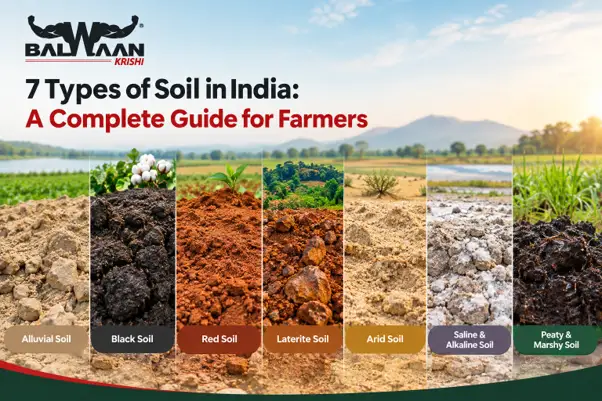
India's seven main agricultural soils are alluvial, black, red, laterite, arid, saline and alkaline, and peaty and marshy. Each holds water differently, carries different nutrients and suits different crops. Knowing which one you farm shapes your crop choice, irrigation plan and fertiliser need. This guide covers how each forms, its key properties, and which crops it supports.
What Is Soil and Why Does It Matter in Agriculture?
Soil is a mixture of four components, and the proportions decide how it behaves:
- Mineral particles from weathered rock, which set texture and nutrient supply
- Organic matter from decayed plants and animals, which builds structure and holds water
- Water, held in pore spaces between particles
- Air, in the pores water does not fill, which roots and soil life need
Two fields can get the same rain and fertiliser and return very different yields, because one holds water in the root zone and the other lets it drain past. That is soil type at work, and why the importance of soil in agriculture is practical rather than abstract: your soil sets the ceiling on what any other input achieves.
How Is Soil Formed?
Soil formation is rock breaking down over long periods, with organic matter accumulating in what is left. Physical weathering cracks rock through heat, cold and water; chemical weathering dissolves minerals out of it; roots and microbes do the rest. Four factors decide the result.
The same four factors, combined differently, produce alluvial plains in the north and laterite hillslopes in the Western Ghats.
7 Types of Soil in India
These are the seven soil types and characteristics that matter most for crop choice, classified by formation, colour and composition.
Alluvial Soil
River-deposited sediment laid down across the Indo-Gangetic plains and coastal deltas, and India's most extensive soil at roughly 43 to 46% of the land area. Texture runs from sandy loam to clay. It is generally rich in potash and lime and usually short on nitrogen and phosphorus, which is why nitrogen is the standard correction here.
Black Soil (Regur Soil)
Formed from weathered Deccan basalt. Its clay content holds moisture exceptionally well, which is how it supports dryland cotton and earns the name black cotton soil. Two working habits follow from that clay:
- It cracks deeply as it dries, aerating itself without tillage
- It turns sticky and unworkable when wet, so tillage timing matters more than on any other soil
Red Soil
Weathered from ancient crystalline rock, with iron oxide giving the colour. It is lighter, more porous and lower in nitrogen, phosphorus and organic matter than alluvial soil, so it drains fast and holds less. With organic amendments and irrigation it produces well: groundnut, millets, pulses and oilseeds all do reliably.
Laterite Soil
Forms where high rainfall and heat leach minerals out, leaving iron and aluminium behind.
- Fertility: low, needs consistent fertilisation for field crops
- Drainage: free, which is what plantation crops want
- Behaviour: hardens when exposed, historically cut into building blocks
- Best suited to: cashew, tea, coffee and rubber, all acid tolerant
Arid and Desert Soil
Sandy, low in organic matter, often alkaline, with salt gathering at depth. Water passes through it quickly, which means irrigation matters more than fertiliser as the first correction. Under canal irrigation, land written off as unproductive now grows wheat and mustard alongside the traditional bajra and pulses, which shows the limit was water rather than the soil itself.
Saline and Alkaline Soil
These develop where drainage is poor, and salts gather at the surface, often when irrigation water evaporates and leaves minerals behind. Salt restricts water uptake by roots, so most crops struggle regardless of fertiliser. Reclamation comes before cultivation, usually through gypsum, leaching with good quality water, and improving drainage so salts move down rather than up.
Peaty and Marshy Soil
Forms in permanently waterlogged land where plant material decomposes slowly and builds up. High in organic matter and acidic. Where water levels can be managed, as in Kerala's Kuttanad region, it grows rice successfully. Where they cannot, drainage is the first problem to solve, and nothing else works until it is.
Note: ICAR's full classification recognises eight major soil groups. The eighth is forest and mountain soil, found across the Himalayas and Western Ghats, thin and humus-rich under tree cover. Most farming guides list seven because little field cropping happens there.
Key Properties of Soil That Affect Crop Growth
Four soil properties do most of the work. Texture and structure decide how water and air move; pH and nutrient content decide what the plant can absorb.
Soil Texture and Structure
Texture is the ratio of sand, silt and clay, and it cannot be changed.
Structure is how those particles clump together, and unlike texture you can change it. Organic matter builds structure; working soil when it is too wet destroys it.
Soil pH and Fertility
pH decides which nutrients a plant can absorb, not how much exist in the soil. Most crops take up nutrients best between roughly 6.5 and 7.5.
- Below 6.5: phosphorus locks up, aluminium can turn toxic to roots
- 6.5 to 7.5: most nutrients available, the target range for most crops
- Above 7.5: iron and zinc become unavailable even when present
A soil test through your KVK or the Soil Health Card scheme is worth more than guessing a dose, because it tells you which of those three situations you are actually in.
Which Soil Is Best for Agriculture?
Alluvial and black soils are generally the most productive across the widest range of crops. Alluvial is fertile, workable and well distributed; black holds moisture well enough to grow cotton with limited irrigation.
But "best" is the wrong frame for a decision already made. You farm the soil you have. Red soil produces well with organic matter and irrigation. Laterite grows plantation crops alluvial soil would not suit. Even saline land becomes productive after reclamation. The useful question is not which soil is best for agriculture, but which crops and practices suit yours. A power weeder suited to your soil behaves very differently in loose red soil than in heavy black cotton soil.
Why Soil Health Matters for Long-Term Farming
Soil type is fixed. Soil health is not, and it is the part you control. Organic matter is the lever, and it does four jobs at once:
- Holds water in the root zone, reducing how often you irrigate
- Feeds the soil biology that makes nutrients available
- Releases nutrients gradually instead of in one flush
- Builds the structure that resists erosion and compaction
As organic matter declines, you compensate with more fertiliser and irrigation to reach the same yield, and the input bill rises every season. As it builds, the opposite happens. The practices that build it are slow: returning crop residue, adding compost and farm yard manure, avoiding unnecessary tillage passes, keeping ground covered.
Tools and Practices That Support Healthy Soil Management
The right practice depends on your soil, and so does the right equipment. Heavy black cotton soil needs working in a narrow moisture window, since it is unworkable when wet and sets hard when dry. Light red and arid soils need shallow passes that do not accelerate moisture loss. Waterlogged land needs drainage first.
Sowing depth and spacing matter more on difficult soils than forgiving ones, which is where manual seed sowing places seed more consistently than broadcasting. For larger holdings, matching a soil preparation tool to soil weight matters: an implement sized for loam will struggle in compacted black soil.
Equipment does not improve soil on its own. It makes the practices that do improve it possible across a full holding, in the days a season allows.
FAQs
1. Which soil type is most fertile in India?
Alluvial soil is the most fertile and most widely cultivated, covering roughly 43 to 46% of India's land area. Black soil rivals it for moisture retention and is preferred for cotton.
2. What is the difference between soil texture and soil structure?
Texture is the proportion of sand, silt and clay, which cannot be changed. Structure is how those particles bind into clumps, improved by organic matter and destroyed by poor tillage.
3. How does soil pH affect fertilizer choice?
pH controls whether nutrients are available to roots. In acidic soil, phosphorus locks up, so lime may help more than extra phosphate. In alkaline soil, iron and zinc need targeted correction.
4. What crops grow best in black soil?
Cotton above all, which is why it is called black cotton soil. Soybean, jowar, wheat, gram, groundnut and sunflower also do well, helped by the soil holding moisture through dry spells.
5. Why is red soil less fertile than alluvial soil?
Red soil weathers from crystalline rock and is naturally lower in nitrogen, phosphorus, humus, and lime. It is more porous, so it holds less water. Organic matter and irrigation close much of the gap.