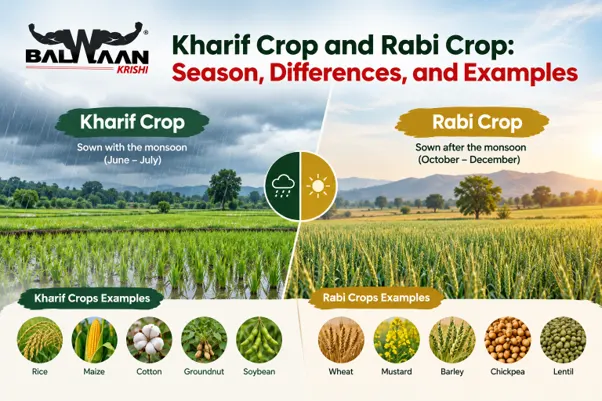
Kharif crops are sown with the monsoon in June and July and harvested from September; rabi crops are sown after the monsoon from October and harvested February to April. Kharif runs on rainfall, rabi on irrigation. That single difference drives almost every planning decision you make. This guide covers both seasons, their timing, the major crops in each, and the differences that change how you sow, water and harvest.
What Are Kharif and Rabi Crops?
Both terms refer to India's main cropping seasons, and both are defined by the monsoon. One grows into it, the other grows after it.
What Is a Kharif Crop?
A kharif crop is sown as the southwest monsoon arrives and grows through warm, humid months. Rainfall does most of the watering, which is why sowing follows the monsoon rather than the calendar.
- Sown: with monsoon onset, June to July
- Water source: mainly rainfall
- Conditions needed: warm, humid, high moisture
- Main risk: a late monsoon delays sowing, a heavy one waterlogs fields that do not drain
What Is a Rabi Crop?
A rabi crop goes into ground that still holds residual monsoon moisture, then grows through the cool, dry winter and ripens as spring temperatures climb. Rainfall contributes little. What matters instead is your irrigation access and how much moisture the soil retained after the monsoon withdrew. The risk profile changes with it: water availability through the season, and an early heat spell arriving while grain is still filling.
Kharif and Rabi Season: Sowing and Harvesting Timelines
The windows below hold across most of India. Shift them by a few weeks for your region, your crop and the monsoon's actual arrival.
Kharif Season Months
Sowing too early risks seed sitting in dry soil. Sowing too late compresses the growing period and pushes harvest into returning rain. Watch the local forecast and the first sustained rainfall, not a fixed date.
Rabi Season Months
Sowing earlier within that window usually helps, because it lets grain fill before spring heat arrives. Land preparation has to move quickly, since the residual moisture you are sowing into does not last.
Did you know? The two seasons now produce almost identical foodgrain volumes. Ministry of Agriculture Second Advance Estimates for 2025-26 put kharif foodgrain at 1,741.44 lakh metric tonnes and rabi at 1,745.13 LMT. Rabi has quietly caught up with kharif, largely on the back of irrigation.
Kharif Crops Examples
Rice is the dominant kharif crop and shapes the season across the eastern and southern states. What the rest share is a need for warmth plus reliable rain or standing water.
Weed pressure builds fast in monsoon humidity, and the gap between rains is short. A power weeder for row crops covers ground faster than hand weeding when that gap is only a day or two wide.
Examples of Rabi Crops
Wheat is the defining rabi crop and the reason the season matters as much as it does. All rabi crops want cool growing weather and a warm, dry finish, and all need water on a schedule rather than when it happens to arrive.
- Wheat — the largest rabi acreage, concentrated across the northern and central plains
- Mustard — oilseed, strong in Rajasthan, Haryana and Uttar Pradesh
- Gram — the main rabi pulse, spread across central India, fixes nitrogen
- Lentil — concentrated in the east, short duration, also nitrogen fixing
- Barley — tolerates poorer and saltier soils than wheat
- Peas — vegetable and pulse use, needs cool weather through pod set
Keeping gram or lentil in the rotation reduces what the following kharif cereal needs from a bag. That is the quiet argument for a pulse in every rabi plan.
Difference Between Rabi and Kharif Crops
The seasons differ in three ways that matter on the ground: what the weather gives you, how you prepare land, and what attacks the crop.
Climate and Water Requirements
The last row is the real difference. In kharif you react to the weather; in rabi you control the calendar, which is why a dependable farm irrigation pump matters more in rabi than in any kharif month.
Soil Preparation Differences
Kharif land preparation is about drainage. Fields need to shed heavy rain without waterlogging, so bunding, channels and levelling do the work. Rabi preparation is the opposite problem. You are conserving what the monsoon left, which means working soil quickly after the previous harvest, avoiding passes that dry it out, and sowing before the top layer loses its moisture.
Common Pest and Disease Risks by Season
Kharif, driven by humidity:
- Stem borers and leaf folders in rice and maize
- Aphids and other sucking pests across several crops
- Bacterial and fungal problems that spread in wet canopy
Rabi, driven by cold and dry spells:
- Pod borer in gram and lentil
- Aphids in mustard
- Rust and blight when cold weather runs long
Scouting timing changes with the season, so a schedule that worked in kharif will miss in rabi.
Important: Pest names and treatment thresholds vary by state, crop variety and year. Follow the product label and your local KVK or state agriculture department for dosage, protective equipment and re-entry timing. Do not carry a spray schedule from one season or district to another.
How to Choose Between Kharif and Rabi Crops for Your Farm
Most farmers do not choose. They grow both in rotation, because the seasons use land in complementary ways and a legume in one improves the other. Where you do have a choice, four things decide it:
- Rainfall pattern — determines whether kharif is dependable or a gamble in your district
- Irrigation access — determines whether rabi is viable at all, since rabi without water is not a season
- Soil type — heavy moisture-retaining soils favour rabi, well-drained land handles kharif rain better
- Market demand — your local mandi rates, which change year to year in a way the first three do not
Weigh the first three once, since they rarely change. Revisit the fourth every year.
Equipment Needs Across Kharif and Rabi Seasons
The two seasons put pressure on different machines, and the pressure is always about timing rather than capability.
Before kharif, land preparation and sowing have to finish inside a narrow window after the first rains, and accurate spacing at sowing pays back all season. That is where a manual seeder for row sowing does more than speed the job up. Through rabi, water management becomes the constraint instead, and rain gun irrigation covers tall or widely spaced crops that drip lines cannot reach economically.
Crop protection runs across both seasons with different targets, so a crop protection sprayer holding steady pressure matters in each. The practical advice is unglamorous: service equipment in the gap between seasons, not in the week you need it.
FAQs
1. Can the same field grow both kharif and rabi crops in a year?
Yes, and most irrigated land in India does. The standard rice-wheat and cotton-gram rotations work exactly this way. The constraint is turnaround time: the kharif harvest has to clear in time for rabi sowing.
2. What is the zaid season, and how is it different from kharif and rabi?
Zaid is the short summer season between rabi harvest and kharif sowing, roughly March to June. It suits quick crops like watermelon, cucumber, muskmelon and fodder, and depends entirely on irrigation.
3. Do rabi crops need irrigation even with winter moisture?
Usually yes. Residual monsoon moisture gets a rabi crop established but rarely carries it to harvest. Most rabi crops need several irrigations, with the one at flowering and grain-filling mattering most.
4. How does soil type affect the choice between kharif and rabi crops?
Moisture-retaining soils like black cotton soil hold water into the dry months and suit rabi crops well. Lighter, well-drained soils handle monsoon rainfall better and suit kharif, provided rainfall is dependable.
5. What happens if kharif crops are sown late?
Late sowing shortens the growing period, which usually reduces yield and pushes harvest into returning rain. If the monsoon is badly delayed, a shorter-duration variety is often a better response than sowing the original crop late.