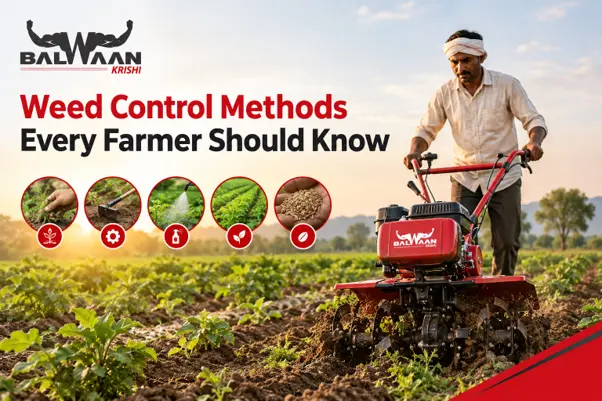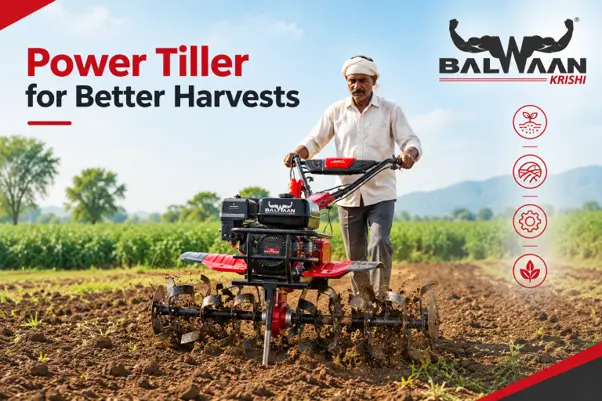
A power tiller is a motorised soil-cultivation machine that takes over the heavy field work that manual labour or draught animals used to handle. Rotating blades on the power tiller cut through compacted earth, giving a farm mechanised tillage without the size or cost of a full tractor.
This guide covers the core power tiller uses, the main machine types, common attachments, and where a mini power tiller fits, especially for small and medium Indian farms. Anyone researching the different uses of power tiller equipment will find the core categories covered below. Balwaan Krishi builds several of the machines and attachments covered below.
What Is an Agricultural Power Tiller?
An agricultural power tiller is an engine-powered machine with rotating blades, used mainly for soil cultivation. It runs on two wheels with handlebar controls instead of four wheels and a cab, which makes it smaller and easier to manoeuvre than a tractor. That size difference is what lets it work narrow fields, orchard rows, and hilly terraces that a tractor simply can't reach.
Primary Uses of a Power Tiller
A power tiller's core uses cover four stages of getting a field ready to plant: breaking and turning the soil, clearing weeds between rows, levelling the surface, and preparing a fine seedbed. Each stage supports the next, and skipping one usually shows up as uneven germination later.
Step 1: Soil Tillage and Ploughing
Rotating blades of the power tiller cut into compacted or previously unworked soil, breaking up hardpan layers that foot traffic and weather leave behind. Turning the deeper layer up brings nutrients closer to the surface and exposes any pests hiding in the soil to sunlight, giving crop roots a workable base to grow into.
Step 2: Weeding and Inter-Cultivation
Weeds growing between crop rows compete directly with the crop for water and nutrients, and a power tiller fitted with narrow tines clears that growth without disturbing the crop itself. A power weeder does a related but more targeted version of this same job. Balwaan's Red Tiger BP-700 power weeder covers a 97cm cultivation width and comes with several interchangeable attachments in one combo. For heavier growth between rows, Balwaan's BP-750E, listed as a power weeder for agricultural operations, adds an electric start to the same cultivation width, useful in the morning when a cold engine won't pull-start easily.
Step 3: Land Levelling
An uneven field surface pools water in low spots and leaves higher patches too dry, which shows up later as patchy germination. Levelling blades on a power tiller flatten ridges and fill in ruts left from the initial tilling pass, so water spreads evenly across the field during irrigation instead of collecting unevenly.
Step 4: Seedbed Preparation and Soil Aeration
Fine seed, particularly vegetable and oilseed varieties, needs a soft, loose bed to germinate well. The tiller's rotating tines break dry clods down into fine crumbs, opening up pore space in the soil so air, water, and nutrients can actually reach the root zone instead of sitting on a crusted surface.
Uses of a Power Tiller Beyond Tillage
A power tiller with the right attachment does more than turn soil. The power tiller's engine and drive system can power a seed drill, a sprayer, a water pump, or a trailer, turning one machine into several tools across the season.
1. Power Tiller with Sowing and Spraying Attachments
A seed-drill attachment lets the tiller open a furrow, drop seed at a set spacing, and cover it in a single pass instead of three separate manual steps. A sprayer attachment does something similar for chemical application, using the tiller's own engine to drive the pump instead of a separate backpack sprayer, covering several rows in one pass.
2. Power Tiller for Water Pumping and Transport
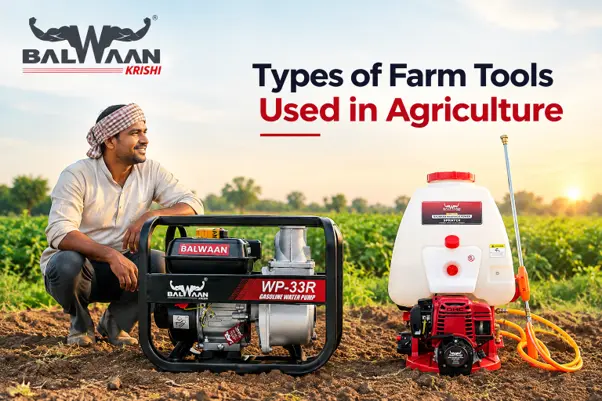
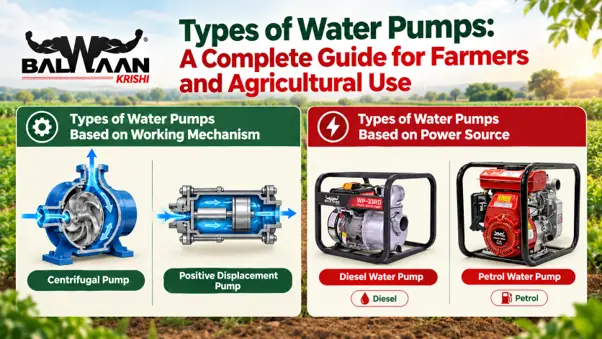
A water pump attachment connects to the tiller's drive system and draws water from a well, pond, or canal, useful for topping up irrigation during a dry stretch without needing a separate standalone pump. Balwaan's WP-22N agricultural water pump covers this same job as a standalone unit for farms that would rather keep pumping and tilling separate. Once harvest is in, swapping the tiller's tillage attachment for a small trailer turns the same machine into transport for produce, manure, or tools across muddy field paths.
Types of Power Tillers
Power tillers fall into three main categories, based on machine size and how the operator controls it: walking behind, riding on top, or handling the compact mini version built for the tightest spaces. Each type suits a different scale of farm.
1. Walk-Behind Power Tillers
The operator walks behind a walk-behind power tiller, steering it through handlebars that carry the throttle, clutch, and gear controls. This is the most common type on Indian farms, since it balances enough weight to cut through soil with enough agility to turn at the end of a row.
2. Seat-Type Power Tillers
A seat-type power tiller carries the operator on a seat, usually mounted over a small trailer or sulky behind the main unit. These run higher-output engines built for bigger plots and heavier soil, where a walk-behind machine would tire the operator out over a full day.
3. Agricultural Mini Power Tillers
An agricultural mini power tiller is the smallest, lightest category, built for kitchen gardens, polyhouses, and narrow hill paths where even a walk-behind tiller struggles to fit. Balwaan's BW-25 mini power tiller weighs under 30 kilograms and covers an 18-inch cultivation width, light enough to carry up a narrow terrace path instead of driving up it.
Which Farms Benefit Most from a Power Tiller?
A tractor still makes sense for large, open holdings, but plenty of Indian farms operate under conditions where a tractor simply can't do the job as well. The situations below are where a power tiller consistently comes out ahead.
- Small and marginal farms, generally under two to five acres, where a tractor's purchase price and fuel use don't pay for themselves against the smaller area worked.
- Wet paddy fields, where a lighter machine moves across soaked clay without sinking the way heavier equipment does.
- Orchards and horticulture plots, where narrow inter-row spacing and low branches leave little room for a tractor to turn.
- Hilly or terraced land, where narrow paths and steep grades rule out four-wheel machines entirely.
Power Tiller Attachments and Their Uses
With the right attachment, a single power tiller can cut crops, lift water, spray, or break up soil. The list below covers the main attachments and what each one does.
- Reaper attachment
Turns the tiller into a harvesting tool for cutting standing crops, so the same machine that prepared the field can help bring in the harvest.
- Water pump attachment
Uses the tiller’s engine power to run a pump, which helps lift and move water for irrigation when a separate pump set isn’t available.
- HTP sprayer attachment
Connects a high-pressure spraying unit to the tiller for applying pesticides, fungicides, or foliar nutrients across larger plots with less manual effort.
- 3-tine cultivator
Loosens and breaks up soil between crop rows and helps with weeding, and it suits lighter inter-row work better than full-field tillage.
Digging holes for fence posts or new saplings is a separate job the tiller itself doesn't cover well. Balwaan's BE-52 earth auger for digging handles that job on its own instead.
Benefits of Using a Power Tiller
A research review of power tiller adoption in India tracked how mechanised farm power available to Indian farmers grew from roughly 0.007 kW per hectare in 1960-61 to over 1 kW per hectare by 2013-14, with power tillers a significant part of that growth on smaller holdings where a tractor wasn't practical.
The following advantages explain why that adoption kept growing on smaller farms in particular:
- Lower purchase, fuel, and service costs than a tractor of comparable capability.
- A job that would take four to six workers several days, like land preparation, finished by one operator in hours.
- Faster seedbed preparation, which means catching a sowing window before the weather turns instead of missing it.
- Less soil compaction than a heavy tractor causes, since a lighter machine puts less weight through the tyres onto the ground.
- Storage that fits a small shed rather than a dedicated tractor bay.
How to Choose the Right Power Tiller for Your Farm
Matching the machine to the farm depends on four practical factors.
1. Farm dimensions and row spacing
Narrow rows under 2.5 feet call for a mini power tiller. Open fields larger than two acres suit a walk-behind machine of 7 HP or more.
2. Soil type
Light sandy soil works fine with a lower-horsepower petrol unit. Heavy clay or dry red soil needs a diesel model with enough torque and weight to actually cut into it.
3. Fuel type
Petrol units start easily, run quieter, and weigh less, which suits smaller machines. Diesel delivers more torque and a lower running cost per hour for continuous work.
4. Attachment needs
Check that the machine has a proper mounting plate and drive shaft if a water pump, sprayer, or trailer is part of the plan, instead of assuming every model supports every attachment.
Power Tiller Maintenance Basics
A few habits keep a power tiller running through the season instead of breaking down mid-task.
- Check the power tiller's engine oil and gearbox fluid before each work session, and change the oil after the first 20 hours of use, then every 50 to 100 hours after that.
- Clean the power tiller's air filter daily during dusty conditions, and replace the paper element once it's visibly clogged.
- Clear wrapped roots, mud, and weeds off the power tiller's tines after each use, and check its blades for bends or cracks before the next session.
- Keep the power tiller's throttle, gear, and clutch cables oiled and properly tensioned, since a stiff cable is often the first sign of a bigger problem coming.
- Before seasonal storage, drain stale fuel from a petrol model, run the carburettor dry, and grease any exposed bare metal on the machine.
None of these take long on their own, but skipped together over a season, they're usually why a tiller needs a costly repair instead of a routine service.
FAQs - Frequently Asked Questions
Is a power tiller better than a tractor for small farms?
For most holdings under three to five acres, a power tiller is better than a tractor for small farms. A power tiller costs less to buy and run, manoeuvres through narrow boundaries a tractor can't fit through, and still handles the core tillage, weeding, and levelling work a small farm actually needs.
What is a mini power tiller used for?
A mini power tiller is built for tight spaces like vegetable gardens, greenhouses, sugarcane inter-rows, and narrow hill paths where even a standard walk-behind tiller is too wide or too heavy to work comfortably.
What attachments can be added to a power tiller?
Common attachments to a power tiller include rotary blades, a reversible plough, a ridger for raised beds, cage wheels for wet paddy work, a seed drill, a sprayer, and a trailer for haulage once harvest is in.
What maintenance does a power tiller need regularly?
Regular upkeep means checking the power tiller's engine and gearbox oil, cleaning its air filter, clearing mud and roots from its tines after use, and keeping its control cables oiled and properly tensioned.
Can one power tiller handle both wet and dry fields?
Yes, with the right attachment change. Swapping standard tyres for cage wheels lets the same machine move from dry vegetable tilling to flooded paddy preparation without needing a second, dedicated machine.