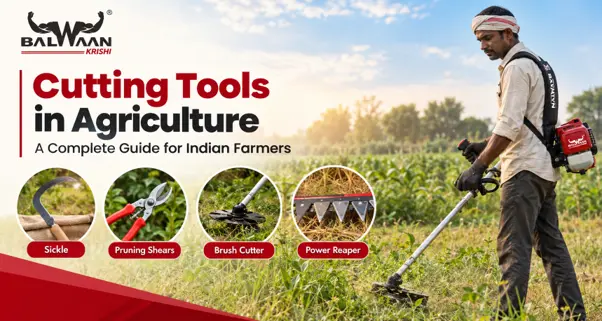
Every stage of a farming season depends on some kind of cutting, from the first weeding pass to the final harvest. Whether a farmer works a marginal one-acre holding, a multi-crop vegetable patch, or a larger grain operation, choosing the right implement affects both harvest yield and running cost directly. Cutting tools in agriculture cover this entire range, from a hand sickle to a powered reaper.
This guide breaks down the main types of agricultural cutting tools, their field uses, how manual and powered options compare, and a practical buying framework suited to Indian farm conditions.
What Are Cutting Tools in Agriculture?
Cutting tools in agriculture are hand-operated or powered implements built to slice, sever, trim, prune, or harvest crops, grass, weeds, and tree branches. They separate plant material through edge pressure, a shearing action, or a fast rotary blade.
These tools fall into two broad categories.
1. Manual and traditional tools, like sickles, harvest knives, and pruning shears, run entirely on physical effort.
2. Powered or mechanised tools, like brush cutters, power reapers, hedge trimmers, and chainsaws, run on petrol engines, mains power, or rechargeable batteries instead.
Why Cutting Tools Matter in Modern Farming
Getting fieldwork done on time decides how a farming season turns out in India. During the kharif paddy harvest or the rabi wheat harvest specifically, delayed work leads to grain shattering, crop lodging from unseasonal rain, and a drop in quality. At the same time, rural labour is often scarce and expensive exactly when a farm needs the most hands, which pushes up wages and delays the harvest further still.
Modern cutting tools close that gap by replacing slow manual work with dependable mechanical cutting. They help a farm finish within its harvest window, keep crop borders free of weeds, and keep an orchard healthy through regular seasonal pruning.
Impact on Labour, Time, and Crop Quality
The wrong cutting tool costs a farm in three concrete ways: how much labour a task needs, whether it finishes in time, and how much the crop itself suffers in the process.
1. Labour
A peer-reviewed field study comparing manual sickle harvesting against a power reaper found the reaper worked 11.2 times faster for rice and 7.16 times faster for wheat, covering roughly 0.35 hectares a day against 0.03 to 0.045 hectares a day for a single labourer working by hand. That gap protects a farm from the worst of peak-season wage inflation and labour shortages.
2. Timing
Harvesting during the crop's ideal maturity window keeps grain moisture at the right level and avoids losses from pests or a sudden change in weather.
3. Cut quality
A dull or wrong tool tears and crushes plant stems instead of cutting them cleanly. A clean cut from a sharp, purpose-built tool protects the plant's own vascular tissue, helps fodder crops regrow faster after a multi-cut season, and keeps fungal disease from getting into a wound on an orchard tree.
Types of Cutting Tools in Agriculture
Agricultural cutting tools range from simple hand blades to motorised machines, and picking the right one starts with understanding what each category can and can't do.
1. Manual and Traditional Farm Cutting Tools
Manual agricultural cutting tools are still the most common cutting equipment on Indian smallholdings. They cost little, need no fuel or charging, and work with precision in tight spaces.
- Sickle (daranti or hansiya): This curved steel blade, set into a wooden or plastic handle, is the most widely used hand tool in Indian agriculture, used mainly for harvesting cereals and cutting fodder.
- Hand pruning shears (secateurs): These spring-loaded, single-handed cutters handle tender branches, grapevines, and vegetable stems.
- Hedge shears: These two-handed, scissor-action cutters trim hedges and boundary shrubs.
- Scythe: This long curved blade sits on a tall handle and is swung with both arms; it was once common but suits few Indian field layouts today.
- Harvesting knives and billhooks: These heavy, cleaver-like blades cut thick stalks like sugarcane and clear dense roadside brush.
Manual and Traditional farm cutting tools work best on small plots, in nursery beds, on terraced land, and anywhere uneven ground or no power access rules out heavier equipment.
2. Powered Agricultural Cutting Tools
Powered agricultural cutting tools use petrol engines, mains power, or batteries to drive a cutting attachment at speed, multiplying how much ground one person can cover in a day.
- Brush cutters: These are the most versatile of the group, fitted with a nylon trimmer head, a metal blade, or a multi-tooth carbide blade depending on the job, and they clear weeds, trim boundary grass, and reap cereal crops.
- Power reapers: walk down a crop row on their own, cutting stalks near the base with a reciprocating cutter bar and laying them in neat rows for collection.
- Chainsaws: run a continuous cutting chain for felling dead trees, cutting thick timber, and thinning overgrown orchard wood.
- Power hedge trimmers: use a double-reciprocating blade to shape hedges and boundary growth quickly and evenly.
Powered agricultural cutting tools suit medium to large holdings, custom-hiring operators, and any farm dealing with a persistent labour shortage.
Common Crop Cutting Tools and Their Uses
A good tool strategy follows the agricultural job rather than the tool category. Matching the cutting mechanism to the specific task keeps the field working efficiently and stops equipment wearing out before its time.
Crop Harvesting Tools for Grains, Fodder, and Vegetables
Grain harvesting needs a tool that cuts stalks cleanly near the soil line without shaking loose the ripe seed heads.
- Paddy and wheat
Hand sickles with fine serrated teeth harvest these reliably. For open fields, Balwaan's PR-700, a petrol-powered reaper for crop cutting, runs a 7HP engine that cuts dense grain stalks close to the ground and lays them in ordered rows ready for bundling.
- Green fodder (jowar, bajra, berseem, Napier grass)
Fodder needs a fast, clean cut that doesn't crush the lower stalk. A brush cutter fitted with a carbide-tipped blade handles thick green stems well, and keeping the cutting height around 5 to 7 centimetres above ground preserves the crown buds that let the crop regrow for another cut.
- Vegetables and fruits:
Harvesting fruits and vegetables needs a gentler touch. Hand secateurs and curved harvesting knives avoid tearing the stem, which matters for shelf life and market value on produce like tomatoes, gourds, and eggplants.
Tools for Weeding and Field Clearing
Weeds left unchecked pull nutrients, moisture, and sunlight away from the main crop, and clearing them takes a durable blade that can handle repeated impact. This is why the right tool depends on what's actually growing.
- Between crop rows
A motorised power weeder cuts through weed roots while aerating the topsoil at the same time. Balwaan's power weeder for farm operations, the BP-800B, is built for this back-rotary style of weeding.
- Heavier growth, thorn bushes, and wild grass along irrigation bunds and field borders
A brush cutter with a metal blade handles both woody brush and root weeds in one pass. Balwaan's BX-35B, a brush cutter with a tiller attachment, cuts growth up to 255mm thick and swaps between a brush-clearing blade and a tiller attachment on the same 35cc engine, useful where a field needs both jobs done without switching machines entirely.
Pruning and Orchard Cutting Tools
Fruit trees like mango, pomegranate, guava, and citrus need regular pruning to thin out water sprouts, remove dead wood, and let sunlight reach the canopy evenly. Which tool does that job well depends mostly on how thick the wood actually is.
- Lower branches and twigs
Hand bypass pruners cut green stems cleanly up to about 20mm thick. An anvil pruner takes over for dead wood instead, crushing through it without the blade twisting out of shape.
- Hedges and shrubs along a farm boundary or a tea garden
Balwaan's HTE-230, an electric hedge trimmer, runs a 60cm double-serrated blade through growth up to 25mm thick, plugged into mains power rather than a battery or petrol tank.
- Branches over 50mm thick
A hand saw becomes slow going here. Balwaan's agricultural chainsaw, the CS-580, cuts through mature limbs and dense orchard wood in seconds instead, and a pole-mounted version handles high branches without needing a ladder.
How to Choose the Right Cutting Tool for Your Farm
Buying the right cutting tool means weighing crop type, field size, operator stamina, and running cost together, not picking on price alone.
1. Match the Tool to Your Crop Type and Farm Size
Soft, fibrous cereal stems like rice and wheat need a fast, serrated cutting edge. Thicker stalks, like sugarcane, maize, or sorghum, need a heavier blade or a power reaper instead. Woody stems in an orchard call for bypass loppers or a chainsaw.
Farm size matters just as much. On plots under two acres, manual sickles and hand pruners are often enough if household labour is available. On three to ten acres, a multi-attachment petrol brush cutter or a power reaper usually pays for itself in labour savings within one to two seasons.
2. Choose the Right Power Source: Manual, Petrol, or Battery
- Manual farm cutting tools need no fuel or charging, cost nothing to run, and suit a smallholder, a narrow terrace strip, or precision pruning work.
- Petrol-powered machines give more power and a longer working day, completely independent of the electrical grid, which suits continuous cutting over a large area, heavy weed clearing, or commercial harvesting, though they need regular oil changes, fresh fuel mixes, and spark plug checks.
- Battery-powered tools run quietly with no exhaust and start at the push of a button, which suits orchard pruning, greenhouse work, and light weeding near a homestead, with run time limited by battery capacity and how often it can be charged.
3. Check Durability, Ergonomics, and Safety Features
Blade material matters over the tool's working life. High-carbon steel, manganese steel, or induction-hardened blades hold an edge longer and resist chipping when they hit a stone.
How the tool feels to hold matters just as much over a long shift. A shoulder harness, vibration-dampening on the drive shaft, and an adjustable handlebar all protect the operator's back and arms across a multi-hour session.
Safety features are non-negotiable on anything motorised: a debris guard wide enough to actually deflect flying stones, a throttle lockout, and an engine cut-off switch within easy reach of the operator's fingers.
Manual vs Powered Agricultural Cutting Tools: Quick Comparison
Manual and powered tools suit different situations. The table below compares them directly on farm size, labour needed, and running cost.
Maintenance and Safety Tips for Farm Cutting Tools
A blunt or poorly kept cutting tool wastes effort, damages crops, and raises the risk of injury. Keeping blades sharp and clean, and handling powered tools safely, prevents most of this.
Blade Sharpening and Cleaning Best Practices
- Sharpen a sickle or brush cutter blade on a flat whetstone or mill file after every 8 to 10 hours of active cutting, following the factory bevel angle, usually 20 to 25 degrees, rather than grinding it flat.
- Clean blades with water and a stiff brush after each workday to remove plant sap and soil, since both encourage rust and dull the edge faster than use alone.
- Disinfect secateurs between plants: Wipe the blade with rubbing alcohol between trees to avoid spreading fungal or viral disease from one plant to the next.
- Store dry: Dry every tool fully before putting it away, and wipe metal surfaces with a light coat of oil to keep rust off during the off-season.
Safety Precautions While Operating Cutting Tools
- Wear protective gear
Heavy gloves, wrap-around eye protection, and closed-toe boots are essential whenever running a brush cutter or chainsaw.
- Keep bystanders back
Children, helpers, and livestock should stay at least 15 metres from any active powered cutter, clear of thrown debris.
- Hold a stable posture
Keep a balanced, two-footed stance on uneven ground, avoid overreaching, and never cut above shoulder height with a handheld chainsaw or brush cutter.
- Shut down before handling
Switch off the engine or disconnect the battery before clearing a tangled stalk, changing a blade, or carrying the tool between plots.
Latest Trends in Agricultural Cutting Tools
New cutting equipment for Indian farms is moving in three clear directions: tools that do more than one job, more battery-powered options, and machines built lighter and easier to handle across a long day's work.
- Multi-attachment machines
A single petrol engine can now switch between a trimmer head, a harvester blade, a mini-tiller, a water pump, and a pole pruner, instead of a farm needing a separate machine for each job.
- Battery-powered tools
These are gaining ground specifically for their quieter, lighter operation, which appeals to orchard and vegetable growers working close to a homestead.
- Better ergonomic design
Lighter frames and vibration-dampening materials are letting operators work longer field shifts without the fatigue older equipment caused.
None of these trends replace the basics covered above, but they're worth watching if a farm is due for its next equipment upgrade.
FAQs - Frequently Asked Questions
What is the difference between cutting tools and harvesting tools in agriculture?
Cutting tools are the broader category, covering any implement that slices vegetation, from weed clearers to pruning shears to brush cutters. Harvesting tools are a specific type within that category, built to gather mature crops, grain, and fruit cleanly at the right height without damaging what's being collected.
Are powered brush cutters better than manual sickles for crop cutting?
For a farm larger than two acres, generally yes. A petrol brush cutter or reaper covers ground several times faster than a manual sickle, which cuts down seasonal labour costs and helps finish the harvest before the weather turns.
What safety gear is needed while using agricultural cutting tools?
Motorised tools call for safety glasses or a face shield, heavy-duty gloves, closed-toe boots, and hearing protection. Manual farm cutting tools need less, but puncture-resistant gloves still prevent the slip cuts and blisters that come with repeated sickle or shear use.
What maintenance is required for petrol-powered cutting tools?
Clean the air filter every 10 to 15 hours of use, check the spark plug for carbon buildup, grease the angle gearbox roughly every 20 hours, and always run fresh petrol mixed at the correct two-stroke oil ratio.
What crops commonly need specialised harvesting tools?
Paddy, wheat, and barley need serrated sickles or a power reaper that won't shake loose the mature grain. Multi-cut fodder crops like berseem and Napier grass need a fast, clean cut that lets the plant regrow, and orchard fruit needs bypass shears that leave the stem intact to preserve shelf life.