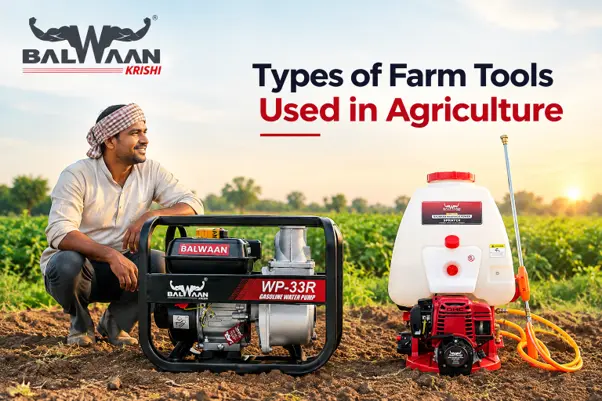
Every farming operation depends on its tools, from a simple hand hoe to a diesel-powered tiller. Farm tools and equipment cover this entire range of agricultural tools, and knowing which ones your farm actually needs, rather than which ones look impressive, saves money and effort across every season.
This guide breaks down agricultural tools by category and use, and helps you tell what's genuinely essential from what's optional. Balwaan Krishi makes equipment across most of these categories, built for the kind of daily use Indian farms actually put tools through.
What Are Farm Tools and Equipment?
Farm tools and equipment are the implements and machines used to prepare field, plant seed, irrigate, protect crops from pests and disease, and harvest the result. Hand tools, like a spade or sickle, run on human effort alone. Powered equipment, like a tiller or a power sprayer, runs on diesel, petrol, or electricity instead, and takes over jobs that would otherwise need several hours of manual labour.
Types of Farm Tools Used in Agriculture
Farm tools fall into groups based on which stage of the farming cycle they're used for, from breaking the soil before sowing to clearing the field after harvest. The sections below walk through each stage in order.
1. Field Preparation Tools
Field preparation comes first in any planting cycle, and the tools used range from fully manual to fully mechanised.
- Spade for digging and turning small patches of soil by hand
- Hoe for breaking up crusted soil and shallow weeding
- Plough for cutting and turning a deeper layer of soil ahead of sowing
- Cultivator for breaking clods and mixing soil after ploughing
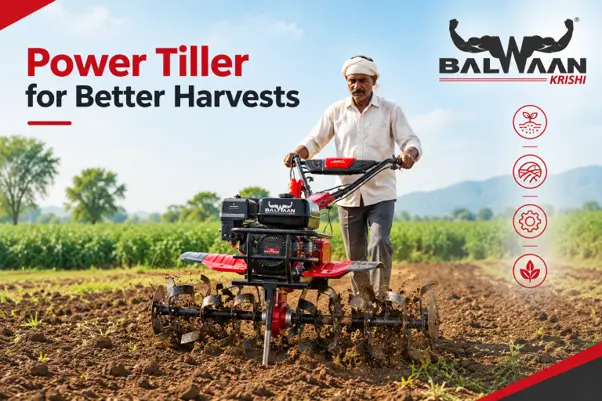
- Power tiller for doing all of the above in far less time on a larger plot
It is important to note that land preparation tends to be the first job farmers mechanise, ahead of sowing or harvesting.
2. Sowing and Planting Tools
Getting seed into the ground evenly matters as much as preparing the soil beneath it.
- Hand seeder for dropping seed at a rough, consistent spacing by hand
- Manual seed drill for placing seed at a set depth and row spacing in one pass
- Dibbler for making individual planting holes at fixed spacing, mainly for transplanted crops
For instance, the Balwaan S-12 seeder, part of the agricultural seeders range, has 12 adjustable mouths and a 6-litre hopper, spacing seed far more precisely across a full row than broadcasting by hand ever could.
3. Irrigation Tools and Equipment
Water reaches a crop through tools ranging from a simple can to a powered pump.
- Watering can for small plots, nurseries, or spot-watering individual plants
- Sprinkler and drip components for spreading water evenly across a bed or field
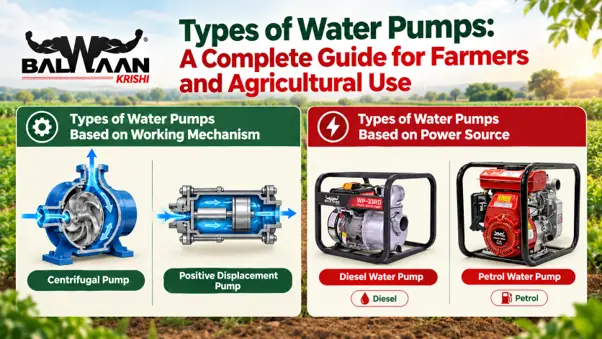
- Water pump (diesel, petrol, or electric) for drawing water from a well, borewell, or canal and feeding it into whichever system the field uses
A pump that isn't self-priming needs air manually cleared from the line before it'll draw water at all, which means stopping to prime it by hand every time it's been idle, an added step on a farm pulling water from a well or canal several times a day. Balwaan's WP-33R agricultural water pump is built self-priming, with a 3-inch suction and delivery size, so it draws water straight from the source without that extra step each time.
4. Crop Protection Tools
Protecting a crop from pests, weeds, and disease depends on getting the right chemical onto the plant in the right amount.
- Manual sprayer (knapsack or hand-pump) for small plots and spot treatment
- Powered sprayer for larger fields or a spraying schedule that comes up often
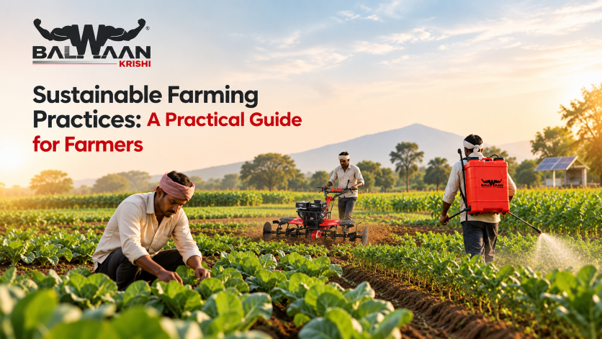
A knapsack sprayer needs constant hand-pumping to keep pressure up, which tires an arm out fast and makes coverage uneven as pressure drops between pumps. Balwaan's BKS-1 agricultural power sprayer runs on its own engine instead, covering pesticide, fungicide, and fertiliser application at a steady pressure without that manual pumping, which matters most once a field is large enough that hand-pumping becomes the bottleneck.
5. Harvesting Tools
Cutting and gathering a mature crop efficiently is the last major labour push of the season.
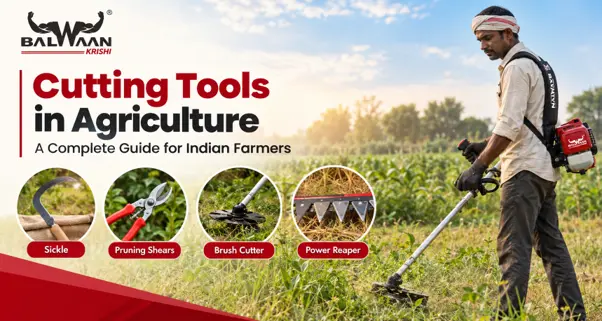
- Sickle for cutting stalks, grass, or fodder by hand
- Hand hook for gathering and bundling cut crop
- Power reaper for cutting and clearing a field considerably faster than a hand crew, which matters most in the narrow window between a crop ripening and the risk of shattering or spoilage
6. Post-Harvest and Farm Maintenance Tools
Once the crop is in, a different set of tools takes over. Processing what's been harvested and maintaining the farm itself both fall into this category.
- Chaff cutter for processing crop residue into fodder
- Brush cutter for clearing scrub, bunds, and field edges
- Earth auger for digging holes quickly, for fence posts, saplings, or similar jobs
Clearing scrub and bunds between the bigger seasonal jobs is where the BX-35 Pro agricultural brush cutter is best used, cutting growth up to 255mm thick with a side-pack harness that's lighter to carry than a back-pack unit. Digging holes for fence posts or new saplings is a separate job entirely. This is why Balwaan offers the BE-4M manual earth auger, built to speed up that job over digging by hand with a spade.
Essential Farm Tools Every Farmer Should Own
Close to 90% of India's agricultural households farm less than two hectares, according to the government's most recent Situation Assessment Survey, so most farms genuinely don't need the full range of equipment covered above. A smaller or first-time farm gets by on a much shorter list of essential farm tools like:
- A spade and hoe for field preparation and weeding
- A sickle for harvesting
- A basic sprayer for pest and disease control
- A watering can or a small pump, depending on the water source
Everything beyond this list, like power tillers, reapers, brush cutters, and earth augers, is genuinely useful but not something every farm needs from day one. Balwaan's 7-in-1 garden tool is a practical starting point for a smaller plot, since it covers several of these basic jobs in a single tool rather than buying each one separately.
Modern Farming Tools Transforming Indian Agriculture
Mechanised tools are steadily replacing manual labour across Indian farms, mainly by saving time and cutting the physical strain of jobs that used to take hours by hand.
Power Weeders and Power Tillers
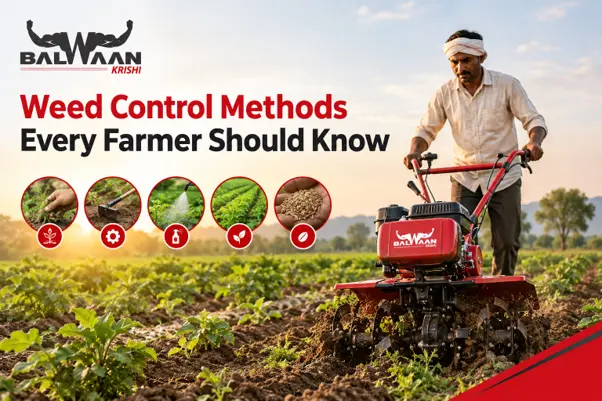
A power weeder or power tiller mechanises weeding and soil turning, cutting the labour a hand hoe would otherwise require. This saves the most time on a medium plot, where hand-weeding by hoe would otherwise stretch across several days. Balwaan's BP-500 power weeder for farming is built lighter than Balwaan's larger models, at 53.6 kilograms with a 13 to 33 inch cultivation width, which suits a smaller or medium plot better than a heavier machine sized for bigger acreage.
Battery and Engine-Powered Sprayers
Powered sprayers themselves split into two types. Battery sprayers run quietly with no exhaust fumes, which suits spraying near a farmhouse, inside a greenhouse, or on a schedule that comes up several times a week. Engine-driven sprayers trade that quiet operation for a bigger tank and a longer run time between refills, which suits a larger field or a full day of spraying in one sitting.
Hand Tools vs. Powered Farm Equipment: Which Do You Need
Hand tools cost less upfront, need no fuel or charging, and work anywhere a powered tool can't reach. Powered equipment costs more to buy but saves substantial labour time, which matters most where hired labour is scarce or expensive during peak season.
Farm size is often the deciding factor. A small plot rarely justifies the cost of a power tiller, while a few acres or more usually recovers that cost within a season or two through labour saved. Available labour matters just as much. A farm that can call on family or hired hands cheaply has less need to mechanise than one that can't.
How to Choose the Right Farm Tools and Equipment
Choosing the right farm tools and equipment depends on five practical factors: farm size, crop type, budget, whether power is reliably available, and how often a tool will actually get used.
- Farm size decides whether a hand tool or a powered one makes sense for a given job.
- Crop type decides which specific tools matter most; a rice farm's tool list looks different from an orchard's.
- Budget decides how much of the move to powered equipment happens in one go versus over several seasons.
- Power availability rules out diesel or electric options where fuel access or grid power isn't reliable.
- Frequency of use decides whether buying outright makes more sense than hiring or borrowing for an occasional job.
Farm Tools and Equipment Maintenance Tips
A few simple habits keep tools and equipment working for years instead of failing early.
- Clean blades and cutting edges after each use, especially after contact with wet soil or chemicals.
- Oil moving parts and hinges on a regular schedule, not just when something starts sticking.
- Store tools away from moisture, since rust and rot are the most common causes of early tool failure.
- Check engines, fuel lines, and oil levels before each season starts, not after a problem shows up mid-use.
None of this takes much time, but skipping it is usually what turns a repairable tool into a replacement.
FAQs - Frequently Asked Questions
What are the most important tools used in agriculture?
A spade, hoe, sickle, and a basic sprayer cover most of what a farm needs day to day. Beyond that, which tools matter most depends heavily on the crop and the specific stage of the season.
Which farm tools are best for small landholdings?
Hand tools generally make more sense on a small landholding, since the labour a powered tool saves rarely justifies its cost on just a hectare or two. A spade, hoe, sickle, and a manual or battery sprayer cover most jobs on a plot that size.
How has modern technology changed traditional farming tools?
Modern versions of traditional tools run on an engine or battery instead of muscle alone. A power tiller does what a plough and cultivator used to do by hand, a power weeder replaces hours of hoeing, and a motorised sprayer covers a field faster and more evenly than a hand pump ever could.
What is the cost range for basic farm equipment in India?
Basic hand tools like a spade, hoe, or sickle typically cost under a few hundred rupees each. Powered equipment costs considerably more, running from a few thousand rupees for a battery sprayer up to tens of thousands for a power tiller or reaper, so it's worth checking current retail prices for the specific tool before budgeting.
What is the difference between farm tools and farm equipment?
Farm "tools" usually refers to simpler, often hand-operated implements, a spade or sickle, for instance, while "equipment" more often means larger or powered machinery, like a tiller or a sprayer. In practice, most people use both terms interchangeably.