A lithium-ion, or li-ion, battery is a rechargeable power source that stores energy chemically and releases it as electricity on demand. It's long been standard in phones, laptops, and electric cars, and it's now showing up in farm equipment too, replacing older battery types and small petrol engines in some farm tools.
This guide covers how a li-ion battery works, what it's made of, the main types, and where it actually fits into agricultural equipment.
What Is a Li-Ion Battery?
A Li-ion battery is a rechargeable unit that stores and releases electrical energy by moving lithium ions back and forth between two electrodes inside it. That's what separates it from a disposable battery, which only discharges once and gets thrown away.
The main advantage is how much energy it packs into a small, light unit. A li-ion battery holds far more charge for its size and weight than the older lead-acid batteries still found in some tractors and sprayers, which is exactly why it's spreading into more equipment.
How Does a Li-Ion Battery Work?
A Li-ion battery works by moving positively charged lithium ions between two sides of the cell, through an internal chemical pathway.
When the battery is discharging, meaning it's actually running a farm machine, lithium ions move from the negative side to the positive side. That movement releases electrons, and those electrons flow out as the electrical current that turns a motor.
When the battery is charging instead, a charger pushes electricity back into the pack. This forces the lithium ions to reverse direction, moving back to the negative side and storing energy there until the next time the farm tool gets used.
What Are Lithium Batteries Made Of?
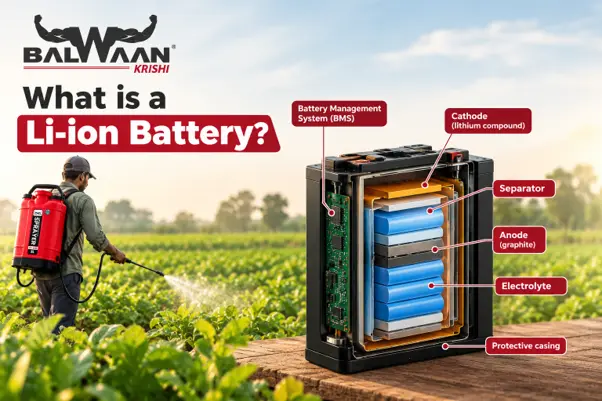
Every lithium battery powering a farm tool relies on the same five basic parts to store and deliver energy safely.
1. Cathode, the positive electrode, is the main source of the lithium ions. It's built from a lithium compound, commonly iron phosphate, nickel, cobalt, or manganese, and this choice is what determines the battery's voltage and how much energy it can hold.
2. Anode, the negative electrode, is where lithium ions sit once the battery is charged. Most modern batteries use a graphite material for this.
3. Electrolyte is the liquid or gel inside the cell that lets lithium ions travel between the anode and cathode, while blocking the electrical current itself from taking a shortcut between them.
4. Separator is a thin, porous film sitting between the anode and cathode. It lets ions pass through while keeping the two electrodes physically apart, which is what prevents a dangerous short circuit.
5. Current collectors are thin metal foils, copper on one side and aluminium on the other, that gather the electrons and carry them out to power the connected farm tool.
What Are the Types of Lithium Batteries?
Not every lithium battery is built the same way inside. The cathode material changes how the battery performs in terms of heat tolerance, run time, weight, and lifespan. A few types show up most often in tools and equipment.
1. Lithium Iron Phosphate (LFP)
LFP batteries use iron phosphate as the cathode material, and they're known mainly for stability and safety. They tolerate heat well and carry a low fire risk compared to other lithium types.
LFP packs weigh a little more than some alternatives, but they last considerably longer, often running for 2,000 to 3,000 charge cycles before losing meaningful capacity. That durability is why LFP shows up in heavy-duty tools and equipment that has to work under demanding field conditions.
2. Nickel Manganese Cobalt (NMC)
NMC batteries combine nickel, which stores a lot of energy, with manganese, which adds structural strength to the cell.
This combination gives NMC batteries a strong mix of energy density and power output in a compact size. That's why they turn up in handheld agricultural cutters, high-pressure washers, and electric vehicles, all tools that need a real burst of power on demand.
3. Lithium Cobalt Oxide (LCO) and Other Types
LCO was one of the earliest lithium battery types, and it packs a lot of energy into a very small space, which is why it's common in phones, tablets, and cameras.
It falls short on cycle life and heat tolerance compared to LFP or NMC, and it doesn't handle heavy power demand well either. For those reasons, LCO rarely shows up in rugged farm tools. A few other types, like Lithium Titanate and Lithium Nickel Cobalt Aluminium Oxide, exist too, but they're built for specialised industrial and vehicle use rather than farm equipment.
What Are Lithium Batteries Used For?
Lithium batteries power everything from small household gadgets to heavy transport, mainly because they pack a lot of energy into a light, steady-output package.
1. Everyday Consumer Devices
Phones, laptops, tablets, wireless headphones, and cordless vacuums all run on lithium-ion cells, which is what lets them work for hours between charges without adding bulk.
2. Battery-Powered Farm Tools and Equipment
Spraying is where lithium power shows up most clearly on a farm today, replacing the tiring hand-pumping a knapsack sprayer needs. Balwaan's Li-Ion Battery Sprayer is one example, an 8-litre model that holds steady pressure across a full tank instead of relying on an arm to keep pumping. Smaller 5-litre and 2-litre versions cover a kitchen garden or a quick spot treatment instead of a full field session.
3. Electric Vehicles and Mobility
Beyond hand tools, lithium batteries power electric two-wheelers, cars, delivery vans, and small utility vehicles. Electric utility carts and light yard tractors also run on lithium packs, moving loads quietly across a farm or orchard.
Why Are Lithium-Ion Batteries So Widely Used?
Lithium-ion batteries have overtaken older options like lead-acid and nickel-cadmium in farm equipment for a few concrete reasons.
- Higher energy density
A peer-reviewed comparison of battery chemistries found lithium-ion cells pack 100 to 265 watt-hours per kilogram, well above what a lead-acid battery of the same weight holds, which keeps handheld farm tools light enough to carry comfortably.
- A longer working life
The same research found lithium-ion cells typically last 800 to 2,500 charge cycles, compared to a much shorter working life for lead-acid batteries.
- Low self-discharge
A lithium-ion pack left in a shed over the off-season loses only around 1 to 5 percent of its charge per month, compared to 15 percent or more for older battery types.
- No memory effect
A lithium pack can be recharged at any point without needing to run it fully flat first, unlike some older battery types.
- Steady power output
A lithium-ion cell delivers consistent voltage right up until it's empty, instead of the gradual power drop a fading lead-acid battery shows.
What Are the Best Lithium Batteries for Farm Equipment?
There's no single "best" lithium battery for every farm job. The right one depends on how well its specifications actually match the tool and the field conditions it'll work in.
Lithium-Ion Batteries vs. Petrol and Diesel Power for Farm Tools
Choosing between a battery tool and a small petrol or diesel farm machine comes down to a handful of practical trade-offs.
Lithium Battery Safety and Maintenance Basics
A few habits keep a lithium battery safe and working at full capacity through years of farm use.
- Keep the battery out of direct, baking sun on a metal farm machine deck, and store it somewhere shaded and ventilated, ideally between 15°C and 25°C.
- Charge it only with the charger it came with. A mismatched charger can bypass the battery's own protection circuit and cause overheating.
- If storing a battery for several months over the off-season, leave it at roughly 50 to 60 percent charge rather than fully drained or fully charged.
- Wipe mud, moisture, or chemical residue off the terminals with a dry cloth before mounting the battery back onto a farm machine.
Skipping these habits is usually what shortens a battery's working life well before its rated cycle count is actually used up.
FAQs
Are lithium-ion batteries safe to use in farm equipment?
Yes. Farm-grade lithium batteries include a battery management system that actively guards against overcharging, short-circuiting, deep discharge, and overheating, and stable battery types like LFP make them well suited to regular field use.
Can lithium batteries be used in wet or dusty field conditions?
Yes, as long as the battery casing carries an adequate ingress protection rating, such as IP54 or IP65. A sealed pack handles routine dust, humid air, and accidental spray mist without issue, though it still shouldn't be submerged or left out in heavy rain.
Is it worth switching from petrol to battery-powered farm equipment?
For tasks like spot weeding, small-plot spraying, and light trimming work, switching to battery power usually saves on fuel and cuts out engine servicing. For heavy tilling or clearing large acreage, a fuel-powered machine still makes more sense, since refuelling is faster than waiting on a charge.
How long does a lithium-ion battery last?
Under normal farm use with correct charging habits, a lithium-ion battery typically lasts 3 to 6 years, or somewhere between 1,000 and 2,500 full charge cycles, before its capacity drops below about 80% of new.
What happens to lithium batteries at the end of their life?
A spent lithium battery should never go into household trash or get burned in a field pit. It needs to go to an authorised electronic waste recycler, who can safely recover the lithium, copper, aluminium, and cobalt inside for reuse.