Wheat is one of India's main rabi crops, and for millions of farmers it's also the main source of both income and food at home. A wrong sowing date, the wrong fertilizer dose, or one missed irrigation can each quietly cost several quintals off your final yield per acre, often without it being obvious which mistake caused it.
Getting the fundamentals right from field preparation to harvest ensures healthy plant growth, stronger grains, and better market rates. This blog covers everything you need to know: the ideal climate, the complete step-by-step wheat cultivation process, a simple fertilizer schedule, and practical solutions to common field problems.
Climate for Wheat Cultivation: Temperature, Rainfall, and Soil Needs
Wheat grows best in a cool, dry climate through most of its cycle, with warmth only welcome right at the end as the grain ripens. Temperature, rainfall, soil type, and sunlight all play a role, and getting any one of them wrong at the wrong growth stage costs yield.
Ideal Temperature at Sowing, Growth, and Ripening Stages
Wheat's temperature needs actually shift across its growth cycle, which is why the same crop wants a warmer spell at one stage and a cooler one at the next:
- Sowing stage: soil temperature around 20°C to 22°C gives the best germination.
- Tillering and vegetative stage: growth is strongest in cooler weather, between 10°C and 15°C.
- Ripening and harvest stage: the crop needs warmer temperatures again, around 20°C to 25°C, to fill and harden the grain.
A sudden heatwave late in winter, or unexpected frost during flowering, can damage grain development and leave the harvest light and shrivelled.
Rainfall, Soil Type, and Sunlight Requirements
- Wheat needs moderate rainfall, ideally 50 to 75 centimetres, and it matters more that this comes spread evenly across the season than in a few heavy spells.
- Well-drained loam or clay-loam soil with a pH between 6.0 and 7.5 suits it best; waterlogged or highly alkaline soil holds the crop back.
- Bright, open, sunny days during grain filling let the plant photosynthesise at its best, which is what produces heavy, plump grains instead of shrunken ones.
Best Sowing Season for Wheat in India (Rabi Timing)
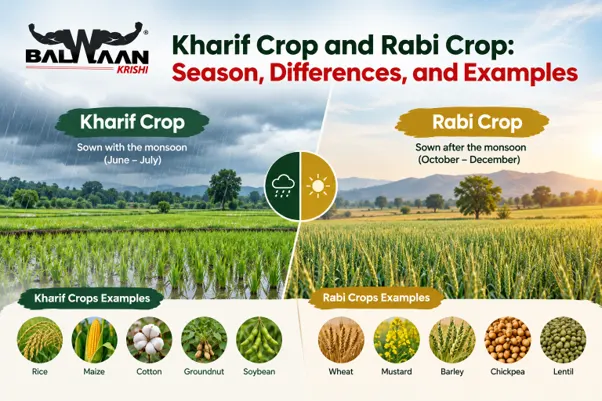
Wheat is a rabi crop, sown after the monsoon ends and harvested before the next summer's heat sets in. Across Northern and Central India, the standard sowing window runs from late October to mid-November.
- Sowing before late October exposes young seedlings to temperatures still too high, weakening their roots before they've had a chance to establish.
- Sowing after November pushes grain filling into hot weather instead, cutting the growth period short and dragging yields down.
A field trial across three districts in Uttar Pradesh and Bihar found that wheat yield fell by an estimated 58 kilograms per hectare for every day sowing was delayed, which is a real reason not to push sowing later than the recommended window even when field preparation runs behind schedule.
Step-by-Step Wheat Cultivation Process
Growing a healthy wheat crop comes down to six stages, from preparing the field to storing the harvest. Skipping or rushing any one of them is where most yield loss actually happens.
Step 1 - Land Preparation and Field Selection
Land preparation covers three passes across the field before sowing:
- Plough the field once with a disc plough, turning over the topsoil and clearing whatever residue the previous crop left behind.
- Two to three rounds of cultivation with a cultivator or harrow come next, breaking the clods down into a fine tilth.
- Finish by levelling the field with a planker. Uneven ground spreads water unevenly later, and seed sitting in a low spot that holds water tends to rot instead of sprout.
Step 2 - Seed Selection, Seed Rate, and Seed Treatment
- Pick a certified, high-yielding variety suited to your region, such as HD 2967, HD 3086, or PBW 550 for the Northern plains.
- Seed rate per acre should follow the variety's own recommendation rather than a general number.
- Normal, timely sowing typically needs about 40 kilograms per acre. Late sowing or bold-seeded varieties push that up to 45 to 50 kilograms
- Treating seed with Carbendazim or Thiram, at 2 to 3 grams per kilogram of seed, protects young crops from soil-borne fungi and smut disease before they even emerge.
Step 3 - Sowing Method, Depth, and Row Spacing
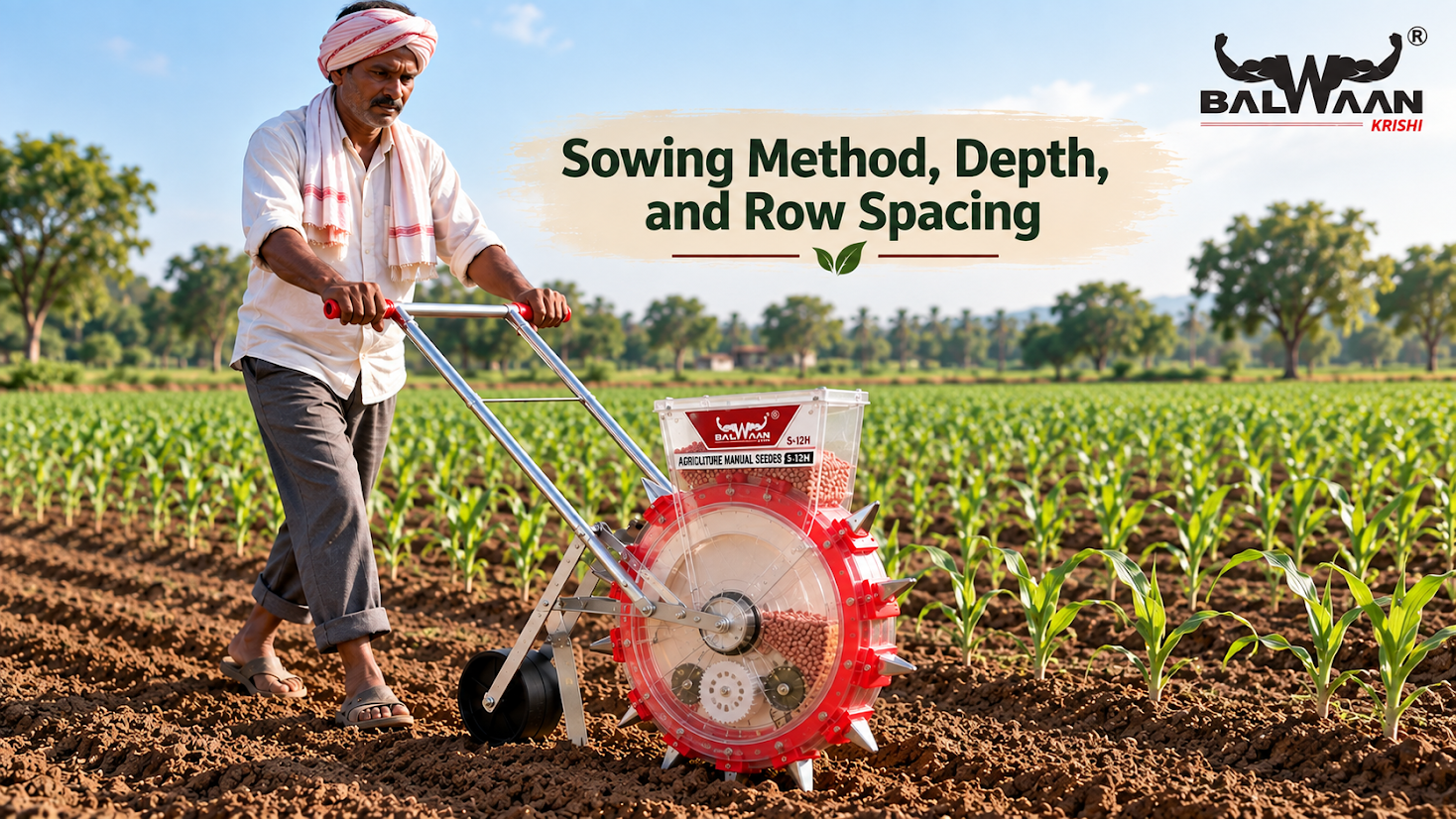
Farmers sow wheat either by broadcasting seed by hand or with line sowing through a seed drill, and line sowing generally gives more even spacing and easier weeding later. For small plots, a manual seeder for wheat sowing like the Balwaan S-12H maal seeder helps plant seeds quickly at uniform depth without tiring manual labor.
Sowing depth and row spacing both affect how well the crop tillers.
- Plant seed 4 to 5 centimetres deep in moist soil; anything deeper than 6 centimetres slows seedling emergence.
- Keep row-to-row spacing between 20 and 22.5 centimetres, since rows set too tight compete with each other for light and nutrients.
Step 4 - Irrigation Schedule at Each Growth Stage
Wheat generally requires 4 to 6 irrigations, depending on your soil type and winter rains:
Moving enough water across a large field on this kind of tight schedule depends on having a reliable pump.
For fields drawing from a well or canal, Balwaan Krishi's WP-33T water pump for wheat fields has a wider 2.89-inch suction and delivery size than a standard pump, covering more ground per irrigation without a long wait between passes.
Smaller plots, or a quick top-up between the main stages, are often better served by a lighter option instead: the WP-15R water pump for wheat irrigation weighs about 11 kilograms and is easy to move between fields.
Step 5 - Weed and Pest Management
Wheat fields deal with a fairly consistent set of problems: weeds competing for nutrients, aphids and termites feeding on the crop, and diseases like rust and powdery mildew that spread fast in humid weather.
- Broadleaf weeds (Bathua, Gazzar ghas) and narrow-leaf weeds (Mandusi / Phalaris minor) compete directly with wheat for sunlight, water, and nutrients. Apply a spray like Sulfosulfuron or Clodinafop 30 to 35 days after sowing, when the soil is slightly moist.
- Watch for termites in dry soil, aphids during warm spring days, and yellow rust (yellow powder under leaves) in damp, foggy weather. Using a portable Battery Sprayer for crop care allows fast, light, and uniform coverage over affected crop patches before pests spread across the entire field.
Regular field monitoring catches most of these early, when a need-based spray still solves the problem rather than a season-wide infestation.
Step 6 - Harvesting and Post-Harvest Handling
Wheat is ready to harvest once the grain hardens and the straw turns golden-yellow, and grain moisture drops below 12% to 14%. Grains should break cleanly between your teeth with a crisp sound.
Harvesting too late risks shattering, where ripe grain drops from the ear before it's collected, so timing matters as much at this stage as it did at sowing. After harvest, the grain needs to be sun-dried on a clean tarpaulin until moisture reaches 10% to 12%.
Then, they need to be stored in clean, dry gunny bags or airtight metal bins raised off cold concrete floors to prevent pest infestations and mould.
Fertilizer for Wheat: Recommended Dosage and Application Timing
Get the fertilizer dose right for wheat and you avoid the deficiencies that stunt a crop halfway through the season, not just at harvest when it's too late to fix. Stalks come out stronger, and grains fill out heavier instead of pinched.
NPK Requirement for Wheat (Nitrogen, Phosphorus, Potassium)
Nitrogen is the nutrient wheat needs most, with phosphorus and potassium needed in smaller, fairly similar amounts. The exact ratio still shifts by region and by what your own soil test shows, so treat any fixed number as a starting point rather than a rule.
For irrigated wheat, a commonly recommended dose is 120 kilograms of nitrogen, 60 of phosphorus, and 40 of potassium per acre, usually written as a 120:60:40 ratio. Converted into the bags you'd actually buy, it looks roughly like this:
When and How to Apply Fertilizer (Basal vs. Top Dressing)
Nitrogen is usually split into two applications: part of it goes in as a basal dose at sowing, and the rest as a top dressing at the first irrigation. Phosphorus and potassium are typically applied in full at sowing instead, since both move through the soil more slowly and don't need a second dose later in the season.
At sowing, apply all of the phosphorus as DAP, all of the potash as MOP, and one-third of the total urea directly into the soil. Apply the second third of urea around the first irrigation, at the crown root initiation stage, 20 to 25 days after sowing. Apply the final third around 40 to 45 days after sowing, at the tillering stage, and stop applying urea altogether once the crop enters flowering.
Organic Manure and Micronutrients for Healthier Wheat
- Working 4 to 6 tonnes of well-rotted farmyard manure or compost into the soil, 3 to 4 weeks before sowing, improves how well it holds moisture through the season.
- Zinc deficiency shows up as yellow bands on young leaves; applying 10 kilograms of zinc sulphate (21%) per acre during land preparation prevents it.
- Sulphur helps grain protein develop properly, so if your soil tends to run short on it, 10 kilograms of bentonite sulphur per acre at sowing makes up the gap.
Common Problems in Wheat Cultivation and How to Prevent Them
A few problems account for most of the yield loss farmers report in wheat, and most of them are preventable with a fix applied early enough:
Farm Equipment That Makes Wheat Cultivation Easier
Seed Drills and Manual Seeders, Irrigation Water Pumps, Battery Sprayers, and Reaper-Binders account for most of what changes a season's outcome. Balwaan Krishi carries each of these, across a range of sizes and price points to suit different farm scales, whether you're working a couple of acres or a much bigger spread. Most products also come with a warranty and access to repair support, so a breakdown mid-season doesn't mean replacing the machine outright. You can check the website or contact the team directly for suggestions on which tools would suit your specific farm.
FAQs - Frequently Asked Questions
1. What is the best time to sow wheat in India?
The ideal window for sowing rabi wheat in India falls between October 25 and November 15. Sowing in this period gives the crop cool conditions for early growth and enough warmth later for the grain to ripen properly.
2. How much seed is needed to sow one acre of wheat?
Certified seed for timely sowing is generally used at around 40 kilograms per acre. For late sowing in December, or for bold-seeded varieties, this increases to 45 to 50 kilograms. Since the exact rate depends on the variety, check the seed packet or consult your local agriculture office for the figure specific to your crop.
3. How many times should wheat be irrigated?
Wheat typically needs four to six irrigations, depending on soil moisture and winter rainfall. The most critical of these is at crown root initiation, 20 to 25 days after sowing, when a delay can noticeably affect tillering and yield.
4. Which soil is best suited for wheat cultivation
Loam or clay-loam soil with good drainage is best suited to wheat cultivation. This soil type retains enough moisture for the crop without waterlogging the roots, a risk that heavier clay soils carry more often. Ideal soil pH ranges between 6.0 and 7.5.
5. What is the ideal fertilizer dose for wheat per acre?
A standard fertilizer recommendation per acre includes one bag of DAP (50 kilograms), 25 to 30 kilograms of MOP, and 90 to 100 kilograms of urea, applied in three split doses. Exact quantities should be adjusted based on your field's soil test results.