Not every field in India gets water the same way. Some farmers still flood their plots by gravity, others run pumps through overhead sprinklers, and a growing number lay driplines that feed each plant one drop at a time. Which method actually reaches your crop matters more each year, as water tables drop, monsoons arrive late, and every litre pumped costs more in diesel or electricity than it did a few seasons ago.
This guide compares the major types of irrigation systems used across Indian farms: surface methods like flood and furrow, sprinkler and centre pivot systems, and drip irrigation. It covers how each one fits different crops, soil types, land sizes, and budgets, so you can match your field to the right method.
What Is an Irrigation System and Why Does It Matter?
An irrigation system supplies water to crops when rainfall alone isn't enough. The method you choose changes how much water you use, how much labour you spend moving pipes or channels, and how much you pay in fuel or electricity every season. A mismatched system wastes water on one end and starves the crop on the other, and both mistakes cost money by harvest time.
Types of Irrigation Systems Used in Indian Agriculture
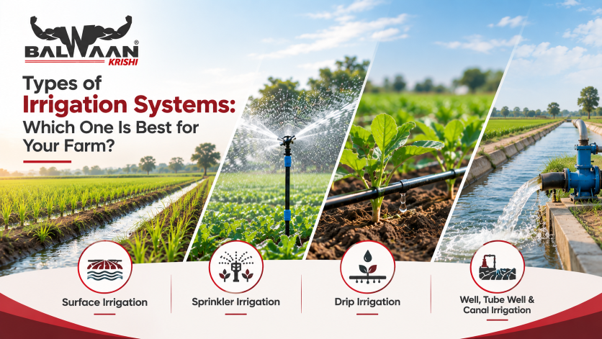
Irrigation methods used in India fall into three broad groups: surface irrigation, sprinkler irrigation, and drip (or micro) irrigation, each suited to different farm conditions. The sections below cover each of these three groups in turn, before looking at the wells, tube wells, and canals that supply water to all of them.
Surface Irrigation
Surface irrigation is the oldest method of irrigation still in wide use across Indian farms today. Water flows across the field by gravity, so it needs no pump pressure beyond getting water to the field's edge. It works well on flat land with a steady water supply, and it's still common for rice and wheat across the Indo-Gangetic plains. It covers a few distinct irrigation methods such as flood, furrow, basin, and border irrigation, each suited to a different field layout.
Furrow irrigation channels water between crop rows, making it a simple and low-cost option for row crops such as sugarcane, cotton, and vegetables.
Sprinkler Irrigation
Sprinkler irrigation sprays water through pressurised nozzles, mimicking rainfall across the field. It suits uneven land where flood irrigation can't spread evenly, and it works well for cereals and crops that don't tolerate standing water. Because coverage is even, sprinklers waste less water than flood irrigation while needing less levelling of the land.
One variant, centre pivot irrigation, uses a rotating arm to water large circular fields on its own, without anyone walking the field. This suits big, flat landholdings where labour is scarce, but the high upfront cost only makes sense to farms operating at that scale. For farms wanting similar spray coverage without that cost, Balwaan's rain gun irrigation setup delivers comparable coverage at a smaller scale.
Drip Irrigation Systems
Drip irrigation systems deliver water straight to the root zone through small emitters, so almost none of it is lost to evaporation or runoff. They suit orchards, vegetables, and water-scarce regions especially well, and let you feed fertilizer through the same emitters, a method called fertigation. Of every system covered here, drip typically saves the most water per crop, which is why water-stressed states keep pushing farmers toward it.
Well, Tube Well, and Canal Irrigation
Most Indian farms don't take water straight from rainfall. They rely on wells, tube wells, or canals as the source that feeds into whichever irrigation method is used above, and which source is available shapes which method actually works and which pump it needs.
India has also expanded irrigation coverage in recent years. The share of gross cropped area covered by irrigation rose from 49.3% in 2016 to 55% in 2021, according to the Economic Survey 2024-25.
Open wells and tube wells
Open wells and tube wells supply water to many Indian farms, particularly in regions such as Punjab, Haryana, and Bihar. Groundwater availability and power supply influence the type of pump farmers use and how irrigation is managed. For farms drawing from a bore well or open well, a farm water pump from Balwaan keeps pressure steady enough for drip or sprinkler lines to work as designed.
Canal Irrigation
Canals supply water to large farming areas in states such as Uttar Pradesh and Bihar, often through fixed rotations known as warabandi. Since canal water is available on a set schedule, farmers need to plan irrigation and field activities accordingly. Larger plots may require a higher-capacity farm irrigation pump for efficient water distribution.
It is important to note that the water source also shapes irrigation planning. A farm on canal water has to time sowing and other field work around its fixed turn, while a farm on its own well or tube well can water on its own schedule instead.
Comparing Irrigation Systems: Water Efficiency, Cost, and Suitability
Once you know how each system works, the real decision comes down to four things: how much water it saves, what it costs to install, how much labour it needs, and which crops it suits.
Irrigation Systems Comparison Table
Exact costs and water savings vary by region, land size, and supplier. Use this table to compare systems relative to each other, not as a fixed quote.
How to Choose the Right Irrigation System for Your Farm
Choosing the right irrigation system for your farm comes down to matching it to your crop, soil, water supply, and budget, not to which one carries the highest price tag or sounds most advanced.
Based on Crop Type
Orchards and vegetables usually do best with drip, since it feeds water and nutrients straight to the roots. Cereals often do better with sprinkler or furrow methods, which cover a wider area without expensive per-plant emitters.
Based on Soil and Land Type
Sandy soil drains fast and needs frequent, light watering, which favours drip irrigation. Heavier clay soils that hold moisture longer, on flatter terrain, work fine with surface or sprinkler systems that apply water in bigger, less frequent doses.
Based on Water Availability and Budget
If your water supply is limited, a water-efficient system like drip saves covers its higher cost over a few seasons. If water is abundant and your budget is tight, surface irrigation, water loss and all, may still be the more affordable choice for now.
Common Mistakes Farmers Make When Selecting an Irrigation System
A few errors show up again and again when farmers choose an irrigation system:
- Picking a system by installation cost alone, ignoring water savings over several seasons
- Ignoring water quality, which can clog drip emitters or damage sprinkler nozzles
- Skipping maintenance planning, so an efficient-looking system breaks down within a year
- Copying a neighbour's choice without checking if their soil, crop, or land size matches yours
Boosting Irrigation Efficiency With the Right Equipment
Whichever irrigation system you choose, and whichever source it draws from, none of it works without a reliable pump moving that water into the field. A weak or poorly matched pump undercuts even the best-designed drip or sprinkler layout, since the whole system depends on steady pressure and flow. At Balwaan Krishi, we build our irrigation water pumps range to match capacity to different well, tube well, and canal setups, so farms of any size can find a proper fit rather than a one-size-fits-all pump.
FAQs - Frequently Asked Questions
1. Which type of irrigation system is best for small farmers in India?
For most small farms, drip irrigation gives the best return, since it saves water and works well on limited land, even though it costs more upfront than surface methods. Where budget is the main constraint, furrow irrigation with better field levelling is a lower-cost starting point.
2. What is the difference between drip irrigation and sprinkler irrigation?
Drip irrigation delivers water directly to each plant's root zone through emitters, while sprinkler irrigation sprays water over the whole field like rainfall. Drip irrigation wastes less water and suits row crops and orchards, while sprinkler irrigation covers wider areas faster and suits cereals.
3. Is furrow irrigation still used in modern farming?
Yes, furrow irrigation is still common for row crops like sugarcane and cotton, mainly because it's cheap to set up. Many farmers pair it with better field levelling or partial drip conversion to cut down its water loss.
4. How much water does drip irrigation save compared to flood irrigation?
Drip irrigation generally uses far less water than flood irrigation, since it targets the root zone directly instead of soaking the whole field. Exact savings vary by soil type, crop, and local conditions, so check with your nearest agriculture extension office for a figure specific to your area rather than relying on a fixed percentage.
5. Which irrigation system is suitable for uneven or sloped land?
Sprinkler irrigation is usually the better fit for uneven or sloped land, since it doesn't rely on gravity flow the way surface irrigation does. Drip irrigation also works on slopes, provided pressure along the line is managed properly.