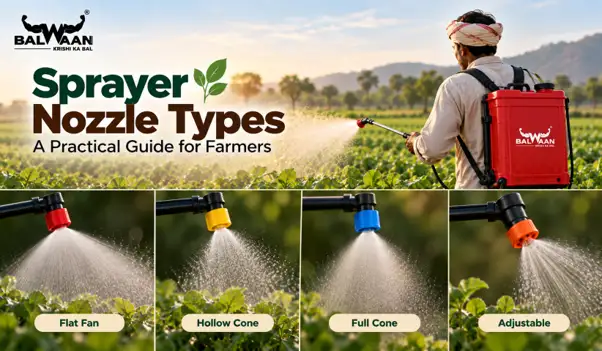
The main sprayer nozzle types are flat fan, hollow cone, full cone and adjustable multi-pattern. Flat fan suits herbicides over open ground, hollow cone suits fungicides and insecticides that must reach leaf undersides, and full cone suits soil-applied treatments. The nozzle decides droplet size and coverage, so it decides whether your chemical reaches the target.
Why Sprayer Nozzle Choice Matters for Crop Protection
The sprayer supplies pressure. The nozzle turns that pressure into a spray pattern, and the pattern does the work. Three things follow from the nozzle you fit:
- Droplet size, which governs whether spray settles on the leaf or drifts off the field
- Spray pattern, which governs whether coverage is even across a pass or heavy in the middle
- Flow rate, which governs how much chemical lands per acre at your walking speed
The consequences are practical, not theoretical. Too coarse and the chemical runs off dense canopy without coating it. Too fine and it drifts onto the neighbouring plot. Uneven and you treat part of the field twice and part not at all, then blame the chemical when the pest survives.
Common Sprayer Nozzle Types Used in Agriculture
Four categories cover most types of nozzles used in agriculture. Each produces a different pattern and suits a different job.
Flat Fan Nozzles
A flat fan produces a narrow, flat, even sheet of spray, and coverage stays uniform across the width of the pass. That uniformity is what broadcast application needs, which makes it the standard choice for herbicides and liquid fertilisers over open ground. Overlap adjacent passes slightly, because output tapers at the edges of the fan and a gap between passes leaves untreated strips that show up later as surviving weeds.
Hollow Cone Nozzles
A hollow cone throws a fine, ring-shaped spray with the centre left open.
- Why it works: fine droplets and the delivery angle move spray into dense canopy and onto leaf undersides
- Typical use: fungicides and insecticides, where the target sits under the leaf
- The trade-off: finer droplets travel further on wind, so drift risk rises
Full Cone Nozzles
A full cone covers a complete circle with coarser droplets and higher volume. Coarse droplets resist drift and settle quickly, which is exactly what soil-applied treatments, pre-emergence herbicides and dust suppression need. The same coarseness works against you on foliage: large droplets run off leaves rather than coating them, so this is not the nozzle for a canopy spray.
Adjustable and Multi-Pattern Nozzles
An adjustable nozzle switches between a solid stream and a spray cone by turning the tip. On a knapsack or battery sprayer that lets you move between tasks in one session without changing hardware.
- Gains: one nozzle covers spot treatment, row spraying and washing down
- Costs: a dedicated nozzle holds its pattern and flow rate more consistently
- Use it when: the job changes more often than precision matters
Most Balwaan sprayers ship with a set of nozzle types for this reason.
Pesticide Sprayer Nozzle Selection by Application Type
The chemical decides the nozzle, not the other way round. Read the label first, since it usually specifies droplet size or spray volume, and that specification is your starting point.
Nozzles for Herbicide Application
Herbicides need to land where you aimed and nowhere else, because drift onto a neighbouring crop causes real and visible damage. Coarser droplets from a flat fan nozzle are heavier, fall faster and travel less on wind. Use the coarsest droplet the label allows when spraying near sensitive crops, field boundaries or in any breeze. Coverage matters less than placement here, since most herbicides work on contact with the weed or through the soil.
Nozzles for Insecticide and Fungicide Application
These need coverage rather than placement. A fungal spore on the underside of a leaf is not treated by spray that lands on top.
- Use: hollow cone or another fine-spray nozzle
- Why: more droplets per litre and better canopy penetration
- When: still conditions, early morning or evening, to limit the drift fine droplets invite
- Watch: pressure, since coverage falls apart if it drops mid-tank
Steady pressure across a long session is where a high-pressure crop sprayer holds an advantage over a hand-pumped unit.
Important: The chemical label is the authority on droplet size, dosage, protective equipment and re-entry timing, and it overrides anything in this guide. Confirm thresholds and product choice with your KVK or state agriculture department. Wear the protective gear the label specifies, and never spray in wind that will carry droplets off your own land.
How to Choose the Right Spray Nozzle
Four things decide it: what you are spraying, what you are spraying onto, what equipment you have, and what the wind is doing.
Matching Nozzle to Your Sprayer Type
Pressure output is what limits your choice.
A battery-powered sprayer holds pressure steadily, which is why its nozzle options are wider than a manual unit's. Fitting a low-pressure nozzle to a high-pressure pump atomises spray into drift.
Considering Droplet Size and Drift Risk
This is the central trade-off in spraying, and no setting wins both ways.
The practical rule: use the coarsest droplet that still gives the coverage the chemical needs, then spray when the air is still.
Checking Flow Rate and Spray Pattern Needs
Flow rate is measured per minute, but what lands per acre depends on how fast you walk. Walk faster than you calibrated for and you under-apply, the pest survives, and you blame the chemical. Walk slower and you over-apply, wasting money and risking crop damage. Calibrate once at the start of the season:
- Mark out a measured area, a tenth of an acre is enough
- Spray it with clean water at your normal walking pace
- Measure how much water you used
- Scale up to per-acre volume and compare against the label
- Adjust your pace or change the nozzle until the two match
Nozzle Maintenance for Consistent Spraying
Nozzles wear from the inside, and a worn nozzle delivers more than its rated flow while producing a poorer pattern.
- Rinse with clean water after every use, including through the lance
- Use a soft brush or compressed air to clear a blockage
- Check output against a new nozzle at the start of each season
- Don't clear a blockage with wire or a pin, which enlarges the orifice permanently
- Don't keep a nozzle once flow has risen noticeably or the pattern looks uneven
Sprayers and Equipment That Support Effective Spraying
A good nozzle on a failing sprayer still sprays badly. Pressure has to hold steady from the first tank to the last, because falling pressure changes droplet size mid-pass and the coverage you calibrated for quietly disappears.
Match the machine to the area. A manual crop sprayer is quick to fill and empty for spot treatment and small plots. A versatile battery sprayer removes hand pumping and holds pressure across a full field. Engine-driven HTP pumps cover orchards and large blocks where hose reach matters more than portability.
Whichever you use, the routine is the same: keep the filter clean, keep nozzles unworn, and calibrate before the season rather than during it.
FAQs
1. What is the difference between a flat fan nozzle and a cone nozzle?
A flat fan sprays a flat, even sheet suited to broadcast herbicide over open ground. A cone nozzle sprays a circular or ring pattern with finer droplets, better for coating foliage and reaching leaf undersides.
2. Which nozzle is best for spraying weedicide?
A flat fan nozzle with coarse droplets. Coarse droplets resist drift, which matters most with herbicides because spray landing on a neighbouring crop causes visible damage. Follow the droplet size on the label.
3. Can the same nozzle be used for both pesticides and fertilizers?
Often yes, if droplet size and flow rate suit both. Rinse thoroughly between chemicals. Herbicide residue in a nozzle later used for foliar fertiliser can damage the crop you are trying to feed.
4. What causes uneven spray coverage in the field?
Usually a worn or partly blocked nozzle, pressure dropping as a manual tank empties, inconsistent walking speed, or passes that do not overlap. Check the nozzle first, since it is the cheapest thing to fix.
5. How often should sprayer nozzles be replaced?
When measured output rises noticeably above the rated flow, or the pattern looks uneven. Check against a new nozzle at the start of each season. Frequency depends on hours used and how abrasive the chemicals are.