Farming in India has changed considerably over the past two decades. More farms now use tractors, mechanised tools, and irrigation systems that follow a planned schedule, instead of relying only on manual labour and animal power. Modern farming techniques cover this change across nearly every stage of crop production, from preparing the field to managing the pressure of harvest.
These methods bring measurable benefits, but they come with real costs too. A higher yield and a faster field turnaround usually mean a higher upfront cost, ongoing machinery upkeep, and, if not managed well, added pressure on soil and water. This blog covers what these methods actually offer, and what they actually cost.
What Are Modern Farming Techniques?
Modern farming techniques are methods that use technology, mechanisation, or scientific input to carry out farming tasks that were traditionally done by hand or based on experience and custom.
Traditional farming depends on manual labour, animal power, seed saved by the farmer, and rainfall, with most decisions made from experience rather than data. A power weeder cuts the time a field preparation job takes. A seed drill places seed at a depth manual sowing can't match consistently. A scheduled irrigation system waters a field on a fixed plan, not whenever rain happens to fall.
Modern methods do not necessarily replace traditional practices. Many Indian farms use a combination of both, applying modern tools where they are most useful while continuing traditional practices elsewhere.
Types of Modern Farming Methods Used Today
Modern farming methods differ in what they actually change. Some change the machinery used, some change the technology behind decisions, some control growing conditions more tightly, and others change which inputs go into the soil or how water reaches the plant. In India, that ranges from a tractor replacing bullocks to a sensor deciding when a field actually needs water.
The main types of modern farming methods include:
- Mechanized Farming
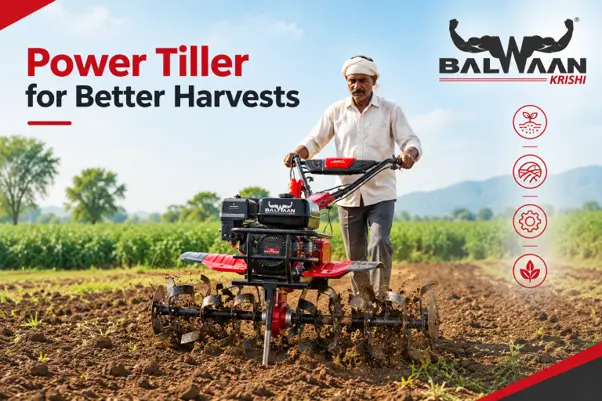
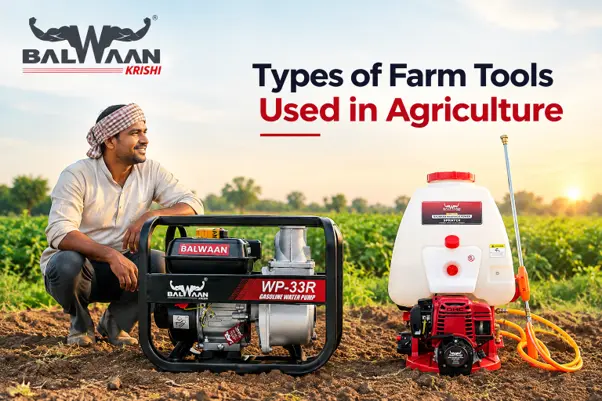
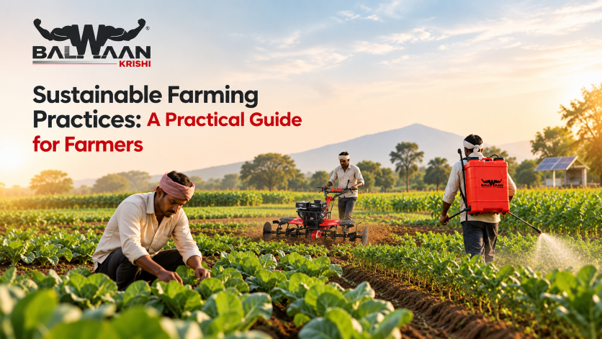
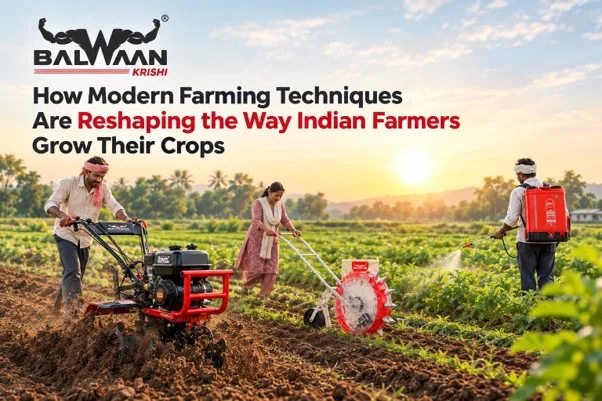
Mechanized Farming covers tractors, power tillers, power weeders, seed drills, sprayers, and combine harvesters, machinery built to take over land preparation, sowing, weeding, and harvesting from manual crews. It matters most where labour is short or a season's working window is narrow, and compact equipment often makes more sense than large machinery on a smaller holding.
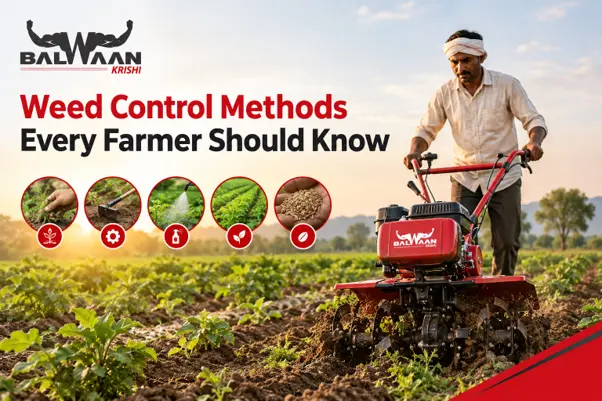
Weeding is usually the first task growers look to mechanise when labour is scarce, since it's repetitive and time-sensitive. Balwaan Krishi's modern weed management tools, like the Black Cheetah Power Weeder, cover up to 43 inches of cultivation width in a single pass, cutting down the number of hands a weeding round would otherwise need.
- Precision Farming
Precision Farming reads a field through GPS, soil sensors, satellite imagery, and drones, picking up on differences in soil, moisture, and crop health that aren't visible from the road. That data lets a farmer put water, fertiliser, or crop-protection input exactly where it's needed instead of dosing the whole field the same way.
A complete precision farming setup, combining sensors, drones, and software, tends to be worthwhile mainly on larger or commercial farms. A smaller holding can apply the same principle through soil testing, measured fertiliser application, and irrigation kept on a schedule.
- Protected and Soilless Cultivation
Polyhouses, net houses, hydroponics, aeroponics, and vertical farming all fall under protected and soilless cultivation, each one controlling growing conditions more tightly than an open field ever could. High-value vegetables, herbs, and similar horticultural crops are where the extra investment is most likely to be worth it.
Growing without field soil, whether that's a hydroponic channel or stacked vertical racks, comes at a price. Real upfront investment, technical upkeep, and dependence on electricity that has to stay on are all part of the trade-off. Not every farm can absorb that.
- Integrated Pest and Nutrient Management (IPNM)
IPNM steps away from routine chemical spraying. Pest monitoring, pheromone traps, and biological controls do the first pass, with chemical treatment kept in reserve for when it's actually needed. Nutrients follow a similar rule. Organic inputs, biofertilisers, and chemical fertiliser go in based on what the soil and crop call for, not a fixed schedule. The point is meeting the crop's needs without overusing inputs or wearing down the soil in the process.
- Pressurized Micro-Irrigation:
Drip lines and sprinklers make up pressurised micro-irrigation, delivering water, and sometimes soluble fertiliser, straight to the root zone instead of across the whole field. Drip suits horticulture and water-stressed land particularly well; sprinklers make more sense wherever overhead watering actually fits the crop. Done properly, controlling where the water lands reduces waste and keeps runoff from becoming a separate problem.
Which of these modern farming techniques actually fits depends on the farm's size, crop, terrain, water access, budget, and labour. A small holding usually benefits more from compact machinery and efficient irrigation than from a big precision system. A commercial horticulture operation is the more likely candidate for protected cultivation or a full precision-farming setup.
Which Modern Farming Method Is Best for Your Farm?
There is no single best farming method for every farm. The right combination depends on the conditions in which the farm operates. Four things actually decide which modern farming method is suitable for your farm:
- Farm size and terrain
Large, open fields often justify larger machinery. Small or fragmented plots tend to suit compact equipment better.
- Budget
The cost of buying, operating and maintaining equipment matters as much as its initial price. Hiring machinery or using shared equipment can be an alternative for small farmers.
- Crop type
Staple crops typically benefit most from mechanised tillage, sowing, and harvesting. High-value vegetables and fruits are more likely to justify drip irrigation or protected cultivation.
- Water availability
Farms facing water shortages may benefit from improving irrigation efficiency before making other major technology investments.
The best approach is often to modernise one operation at a time. A farmer facing a labour shortage during weeding, for instance, may gain more from a suitable power weeder than from investing in an expensive precision-farming system.
Benefits of Modern Farming Techniques
When appropriately selected and managed, modern farming techniques can provide several practical benefits.
- Higher Productivity
Correct seed placement, timely field preparation, balanced nutrients instead of guesswork, and early pest detection together create more favourable conditions for crop growth.
- Faster Farm Operations
A machine completes work that would take a manual crew several days, and that speed matters most in the narrow windows around sowing and harvest, where a delay pushes back everything that follows. Mechanised sowing is a clear example. It plants more consistently than broadcasting by hand and cuts the time spent doing it. Balwaan Krishi's modern seed sowing tools, like the S-12H manual seeder, bring that kind of consistency to a farm's own sowing.
- Reduced Dependence on Manual Labour
Peak season is when labour gets hardest to find, and it's exactly when tilling, weeding, sowing, and general crop maintenance all need doing. Mechanised tools take the repetitive physical load off that narrow window.
- Better Use of Inputs
Precision application and better irrigation let a farmer use water, seed, fertiliser, and crop-protection inputs more deliberately. It isn't about using more technology for its own sake. It's using the right input, at the right time, in the right amount.
Disadvantages of Modern Farming
Modern farming improves productivity and efficiency, but it also brings financial, operational, and environmental challenges. Some of the common disadvantages of modern farming include:
- Higher Costs and Technology Dependence
Machinery, irrigation systems, sensors, and protected cultivation structures all cost real money upfront. After that, fuel, spare parts, commercial inputs, and technical service calls keep adding up season after season. Custom Hiring Centres and shared machinery are two ways smaller farms manage this cost without buying everything outright.
- Effects on Soil and Biodiversity
Deep tillage done repeatedly, heavy machinery passing over the same ground, and excess fertiliser use all wear down soil over time, showing up as compaction, nutrient imbalance, and declining fertility. Growing the same crop season after season and relying on the same chemicals also narrows the range of plant and insect life a field supports. Crop rotation, added organic matter, and integrated pest management all help slow this down.
- Water Use and Loss
Irrigation that isn't managed carefully wastes water outright. Fertiliser and pesticide left unused in the field can wash into nearby water sources as well. A well-designed and properly run drip or sprinkler system avoids most of this.
How much damage modern farming actually causes depends on how the technology and inputs get used, not the technology itself. A farm that pairs modern methods with responsible soil, water, and crop management keeps its output high without trading away long-term sustainability for it.
How the Right Farm Equipment Supports Modern Farming Practices
Modern farming in India is being supported by Ministry of Agriculture & Farmers Welfare initiatives such as agricultural mechanisation, Soil Health Cards, and the Per Drop More Crop initiative, which aim to improve how farmers manage resources, crops, and farm operations.
For farmers, adopting these practices does not always mean investing in expensive technology all at once. Choosing the right equipment for a specific task cuts manual effort without the cost of modernising everything at the same time.
Balwaan Krishi makes equipment across these categories, backed by spare parts and after-sales support for keeping machines running.
Farmers who add equipment gradually, matched to their crops and resources, tend to get more value from modern methods than those who try to modernise everything at once.
FAQs - Frequently Asked Questions
1. What is the difference between modern farming and traditional farming?
Traditional farming runs on physical labour, draft animals, seed saved from last season, and the monsoon. Modern farming replaces those with motorised equipment, scientific seed varieties, managed micro-irrigation, and a planned nutrient schedule, aimed at steadier yields and faster fieldwork.
2. Is modern farming better than traditional farming?
Not in every case. Modern methods raise output per acre and cut labour, but need more capital and careful management to keep the soil from wearing down. Traditional methods cost less and cause less environmental harm, at the cost of lower yield. Most working farms end up running both together rather than choosing one.
3. What is the most common modern farming method used in India?
Mechanised farming, using tractors, rotavators, power weeders, and motorised sprayers, is the modern method most Indian farms actually use. Drip irrigation is also widely used, especially where water is scarce, and the crop is vegetables or cash crops.
4. How can small farmers adopt modern farming methods affordably?
Custom Hiring Centres, cooperative implement-sharing, and SMAM's state subsidies all bring the entry cost down for a smallholder. Going compact instead of full-sized commercial machinery reduces the remaining cost further.
5. How is climate change affecting modern farming practices?
The monsoon arrives less predictably than it used to, heatwaves stretch longer, and unseasonal rain gives less warning before it hits. Growers are responding with climate-resilient varieties, mulching to hold soil moisture, and closed drip-irrigation systems built to handle that kind of weather stress.