The tools used for farming decide how much labour a season takes, how much fuel or electricity it burns, and how much of the harvest actually gets saved rather than lost to weeds, pests, or a late-prepared field. A spade and a sickle can still do the job on a small plot, but a power tiller, power weeder, or sprayer often does the same job much faster.
This blog covers the tools used for farming across Indian fields, from basic hand tools to powered equipment like power tillers, power weeders, brush cutters, sprayers, and water pumps. It explains what each one actually does and how to choose between them based on your land size, crop, and budget.
Why the Right Farming Tools Matter for Productivity
Mechanised equipment can reduce the amount of manual labour and time needed for farm operations. An ICAR study found that farm mechanisation can reduce labour requirements and operating time by around 20–30%, while also improving input efficiency and cropping intensity.
The choice of equipment, however, should be based on the farm's size, crop, and budget. A machine that works well for one farm may not be the right fit for another.
Categories of Tools Used for Farming
Tools used for farming split into five broad groups: manual hand tools, soil preparation and tillage tools, weed and vegetation management tools, crop protection tools, and water management tools. Each group is covered below, along with the specific equipment that falls under it.
1. Manual and Traditional Farming Tools
Even on farms that have moved to powered equipment, a few hand tools stay in daily use, especially on small plots where a powered machine wouldn't be worth the cost:
- Spade for digging, turning small patches of soil, and cutting through roots by hand
- Hoe for shallow weeding and breaking up crusted soil between plant rows
- Sickle for cutting stalks, grass, or fodder where a machine can't reach or isn't worth bringing out
- Rake for clearing crop residue, levelling soil, and gathering cut grass or straw
These tools cost little, need no fuel, and work anywhere a powered machine can't, which keeps them in daily use even on farms that have mechanised most other work. Balwaan Krishi's hand tools for gardening cover the basics above at prices suited to a small plot.
2. Soil Preparation and Tillage Tools
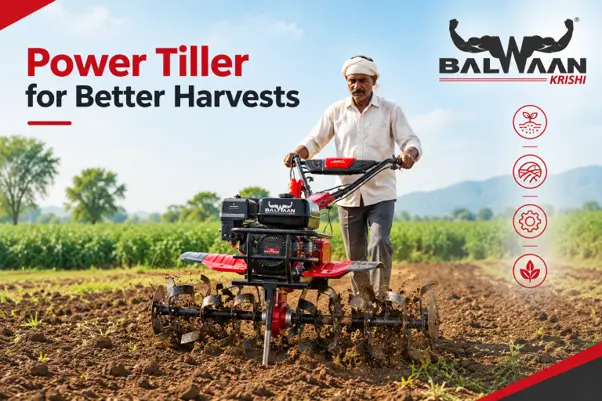
Breaking and preparing the soil is the first real step in any planting cycle, and mechanised tillers have replaced traditional ploughing for most Indian farmers. A power tiller handles several of these early-season jobs in a single pass:
- Breaking up compacted or previously unploughed soil
- Preparing a fine, even seedbed ready for sowing
- Light weeding between rows once early growth appears
A power tiller suits small and medium landholdings better than a full tractor in many cases, since it costs less to buy, run, and maintain, and it manoeuvres more easily on smaller or irregularly shaped plots.
3. Weed and Vegetation Management Tools
Keeping fields, bunds, and orchards free of weeds and overgrowth protects crop health and keeps pests from having anywhere to hide.
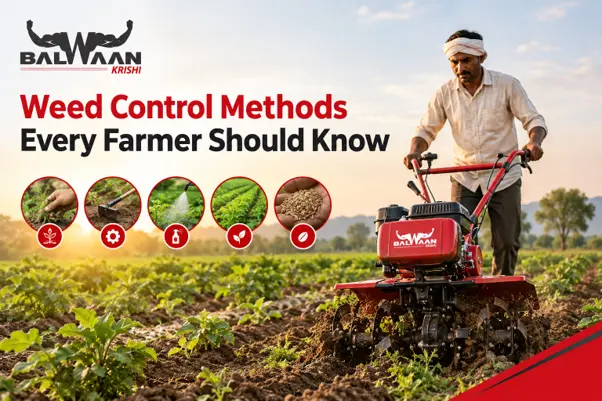
- A power weeder removes weeds growing between crop rows without damaging the crop itself, cutting out most of the manual weeding labour a field would otherwise need. Balwaan Krishi's BP-700 power weeder for farming has a cultivation width of up to 43 inches and comes with a rotary tiller attachment, so one pass covers a wider strip between rows and can double up on light tilling.
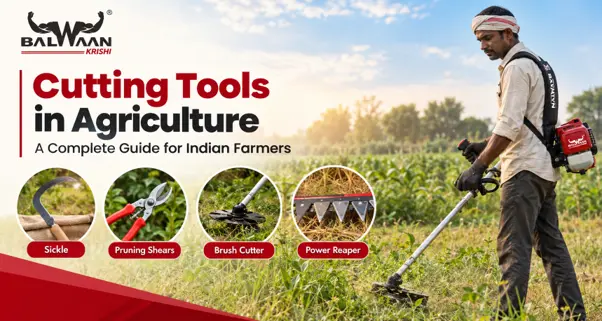
- Brush cutters clear dense grass, bunds, and field edges faster than a sickle can, and they're just as useful outside crop fields, on orchard floors and fence lines. For that heavier, denser growth a power weeder isn't meant for, Balwaan Krishi's BX-35 Pro brush cutter for farming cuts growth up to 255mm thick and uses a side-pack harness, which is lighter to carry through bunds and edges than a back-pack unit.
4. Crop Protection Tools: Sprayers for Pest and Disease Control
Spraying protects a crop from pests, weeds, and disease, and timely, even coverage matters as much as the chemical itself. Choosing the right agricultural sprayer usually comes down to field size and what's being applied:
- Knapsack sprayers, carried on the back, suit small plots and spot treatment
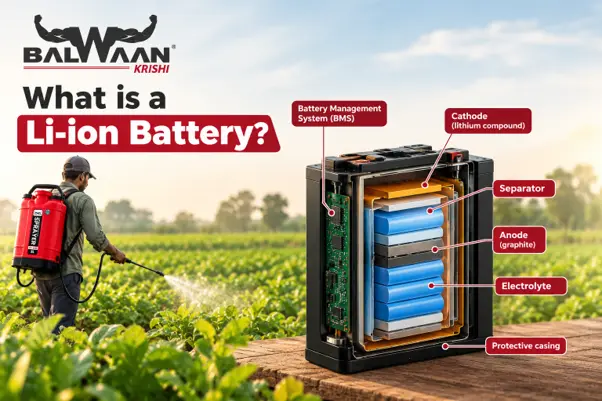
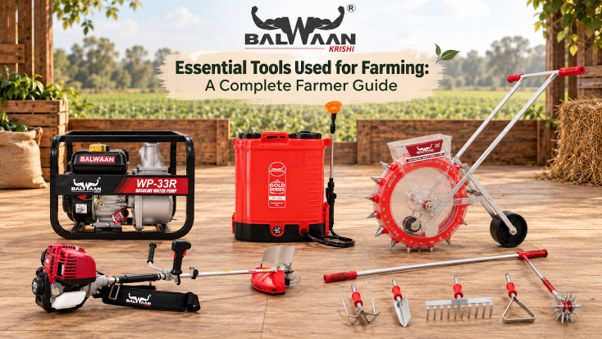
- Battery-operated sprayers cut out the manual pumping action, useful for longer sessions without fatigue. For small to medium plots, the Gold Series BS-30G in Balwaan Krishi's battery sprayer for farming lineup covers most day-to-day spraying without the manual pumping a knapsack needs.
- Power sprayers run on an engine and cover larger fields faster, at a higher upfront cost.
5. Water Management Tools for Irrigation
Reliable water delivery is one of the most critical inputs on any farm, especially in regions with less rainfall or limited canal access.
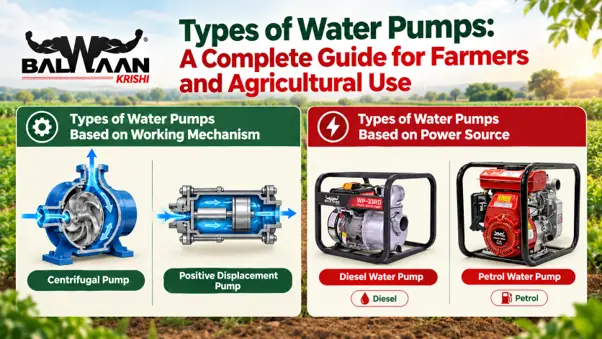
A water pump draws water from a well, borewell, or canal and feeds it into whichever irrigation system the field uses, and the choice between a diesel and an electric pump usually comes down to fuel cost and how reliable the local power supply is.
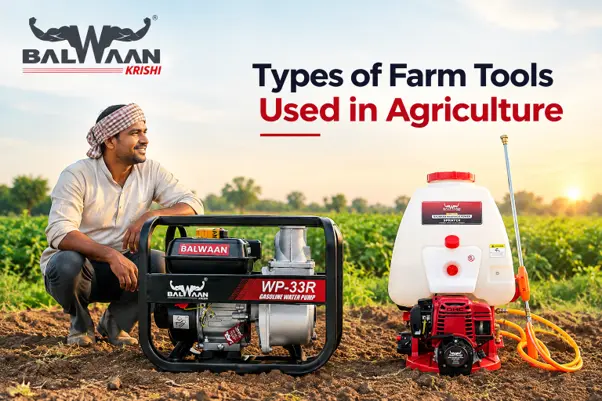
For a petrol-powered water pump for irrigation, Balwaan Krishi's WP-33R is a self-priming option with a 3-inch suction and delivery size, so it draws water quickly from a well or canal without needing to be primed by hand each time.
How to Choose the Right Tools Used for Farming
Choosing the right tools used for farming comes down to matching them to your land size, crop type, water source, budget, and available labour, rather than buying whichever tool looks most advanced.
1. Matching Tools to Farm Size and Crop Type
The size of the field is a good starting point, but it is not the only consideration. On smaller plots, compact tillers and power weeders are easier to handle, while larger areas may call for equipment with greater working capacity. Crop layout matters too. Narrow rows need equipment that can move between plants, whereas orchards, bunds, and overgrown areas are often better suited to a brush cutter.
2. Budget and Maintenance Considerations
Look beyond the price on the machine when comparing options. A lower-priced machine may not work out cheaper if it needs frequent repairs or is expensive to operate. It is also worth considering how often the equipment will be used and whether the expected labour savings justify the cost.
Before choosing a tool, consider:
- How much fuel or electricity it'll use if you're running it daily
- Servicing, oil changes, filters, and the other regular upkeep it needs
- Whether spare parts are actually stocked nearby, not just available online
- Local after-sales support, since not every area has a service point close by
- How many seasons you'll realistically get out of it
- Where you'll store it, and whether you can move it between fields easily
- Whether it takes other attachments, in case you need it for more than one job
The best choice is therefore not always the cheapest machine. It is the one that fits the farm's workload, can be maintained locally, and provides useful service over several seasons.
Maintenance Tips to Extend the Life of Farm Equipment
You've already spent money on a power tiller, weeder, sprayer, or pump, so getting years of use out of it instead of just a season or two comes down to a few simple habits:
- Clean equipment after each use, especially sprayers and pumps that carry chemicals or muddy water
- Service engines and moving parts on a regular schedule, not just when something starts making noise
- Store equipment under cover, away from rain and direct sun, when it's not in use
- Check fuel and oil levels before each use rather than after a problem shows up
Following the manufacturer's maintenance schedule and addressing unusual sounds, leaks, vibration, or reduced performance early can also help prevent minor issues from becoming expensive repairs.
Balwaan Krishi offers a range of farming tools, from power tillers and weeders to sprayers, brush cutters, and water pumps. You can speak to the Balwaan team if you need help finding equipment suited to your farm.
FAQs - Frequently Asked Questions
1. What is the difference between a power tiller and a power weeder?
A power tiller breaks and prepares the soil before sowing, turning and loosening it for a seedbed. A power weeder works after the crop is already growing, removing weeds from between the rows without disturbing the crop itself.
2. Which tool is best for small farms in India?
For most small farms, a power tiller and a power weeder together cover the two tasks that take the most manual labour: soil preparation and weeding. A knapsack or battery sprayer is usually the next tool worth adding, since spraying needs come up in nearly every crop cycle.
3. How do I choose between a diesel and electric water pump?
The choice usually comes down to your local power supply and fuel cost. A diesel water pump will run even where the grid supply isn't reliable, though it costs more per hour in fuel than an electric pump costs to run wherever the power supply holds up.
4. What type of agricultural sprayer is best for small vegetable plots?
For a small vegetable plot, stick with a knapsack or battery-operated sprayer. Both are light enough to carry through tight rows, and neither needs the fuel or upkeep a bigger power sprayer does.