Tired, nutrient-poor soil directly limits crop yields and cuts into farm profits every season. When the ground loses its vitality, crops struggle to grow, fertilizers stop delivering results, and irrigation water quickly drains away or runs off.
To improve soil fertility, combine organic matter additions, soil testing, balanced crop nutrition, and gentle tillage practices. This approach restores native biological activity and builds durable soil structure for steady harvests over time.
This guide provides practical, natural, and balanced techniques tailored for Indian agricultural conditions. The following sections walk through soil nutrients, testing steps, organic amendments, mechanical field preparation, and a simple seasonal roadmap to protect your land for years to come.
What Is Soil Fertility and Why the Importance of Soil Fertility Matters
Soil fertility refers to the capacity of farm soil to supply essential plant nutrients, clean air, and moisture in balanced amounts while providing a non-toxic, loose root zone. Fertile ground does more than simply hold a plant upright; it actively sustains biological growth across all weather conditions.
Understanding the importance of soil fertility helps farmers make sound financial choices. When your soil retains natural fertility, input costs drop because every kilogram of added fertilizer functions efficiently. Healthy root zones yield uniform harvests, protect seedlings against dry spells, and protect farm income across changing seasons.
Key Nutrients and Soil Properties That Make Soil Fertile
Five factors in the right balance determine the fertility of soil, and a shortage of any one of them can compromise crop fertility.
1. Main nutrients (NPK)
Nitrogen (N) builds green leaves and stems. Phosphorus (P) helps roots form and flowers develop. Potassium (K) controls water movement inside the plant and helps it stand up to drought and disease.
2. Organic matter
This is the decayed remains of plants and animal dung in the soil. It holds water and nutrients close to the roots.
3. Soil structure
Good soil breaks into small, loose crumbs with air spaces between them, so roots can breathe and rainwater can soak in.
4. Soil pH
pH measures how acidic (sour) or alkaline the soil is. At the wrong pH, roots cannot take up some nutrients even when they are present in the soil.
5. Soil life
Earthworms, fungi and bacteria break down manure and crop waste into a form that roots can absorb.
Why Soil Fertility Matters for Yield, Water Retention and Sustainability
Fertile soil raises yield, holds water longer between irrigations and keeps the land productive for future seasons..
Roots in fertile soil grow deeper, so they keep finding water and nutrients while the grain or fruit is filling. Loose soil with plenty of organic matter also soaks up heavy rain instead of letting it run off, and it stays moist for longer when there is no rain for several weeks.
Many Indian fields are already short of the basics. A 2025 analysis by the Centre for Science and Environment of the government's Soil Health Card data found that about 64% of Indian soil samples tested were low in nitrogen and nearly half were low in organic carbon. Rebuilding these levels protects the land your family will farm for years to come
Signs of Low Soil Fertility and How to Test Your Soil
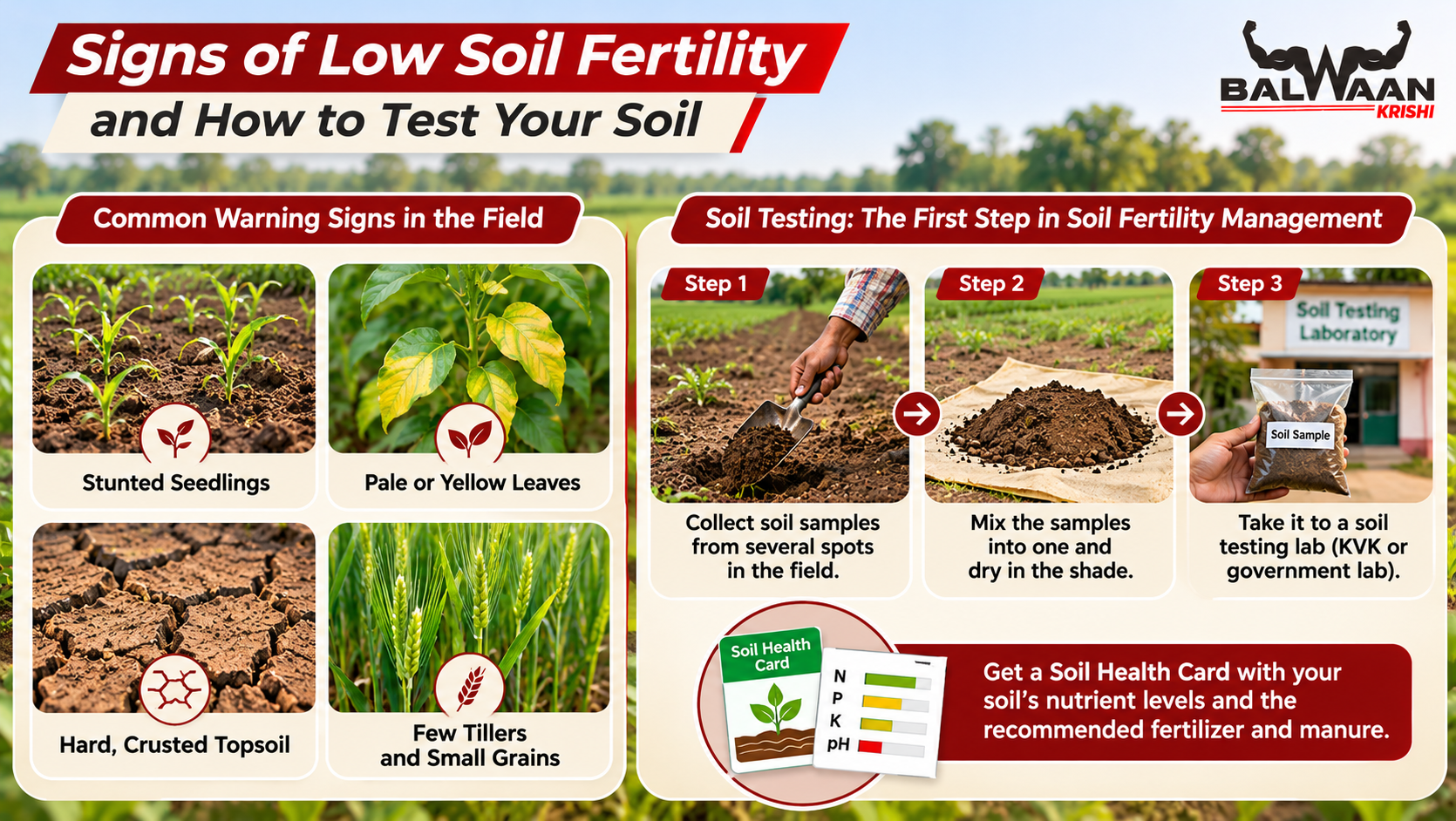
Low soil fertility shows up as slow, pale or patchy crops. A soil test tells you which nutrient is actually short before you spend money on fertilizer, since adding the wrong one can make an imbalance worse.
Common Warning Signs in the Field
Low fertility usually shows first in young plants and in the topsoil itself.
Stunted seedlings: Plants grow slowly and stay short, with thin stems and few branches.
Pale or yellow leaves: The lower leaves turn pale green or yellow early in the season. This often points to a shortage of nitrogen or of a micronutrient such as zinc.
Hard, crusted topsoil: Soil forms a crust after rain and turns rock-hard as it dries, so water runs off instead of soaking in.
Few tillers and small grains: Tillers are the side shoots that grow from the base of wheat, rice, and other cereal plants. Poor soil gives fewer tillers, and pods or ears stay half-filled.
Pests, root disease, and lack of water can cause the same signs. If the soil test shows no shortage, ask your local Krishi Vigyan Kendra (KVK) to check the crop for these other causes.
Soil Testing: The First Step in Soil Fertility Management
The first step in soil fertility management begins with systematic soil testing. A soil test is a laboratory check of which nutrients your soil has and which it lacks, and soil fertility management starts with it. The lab measures nitrogen, phosphorus, and potassium, along with sulphur, micronutrients, organic carbon, pH, and salt level. For accurate soil testing results, follow these steps:
Step 1: Collect samples from several spots across the field, walking in a zig-zag line. Avoid manure heaps, bunds and the shade under trees.
Step 2: Mix the samples into one, and dry it in the shade.
Step 3: Take it to a testing lab, such as your nearest KVK or a government soil testing laboratory.
Under the government's Soil Health Card scheme, the report comes as a card that lists your soil's nutrient levels and the fertilizer and manure it needs. You can then buy only what your field is short of.
Methods to Improve Soil Fertility at a Glance
Seven methods to improve soil fertility work on most Indian farms, and most farmers combine several of them.
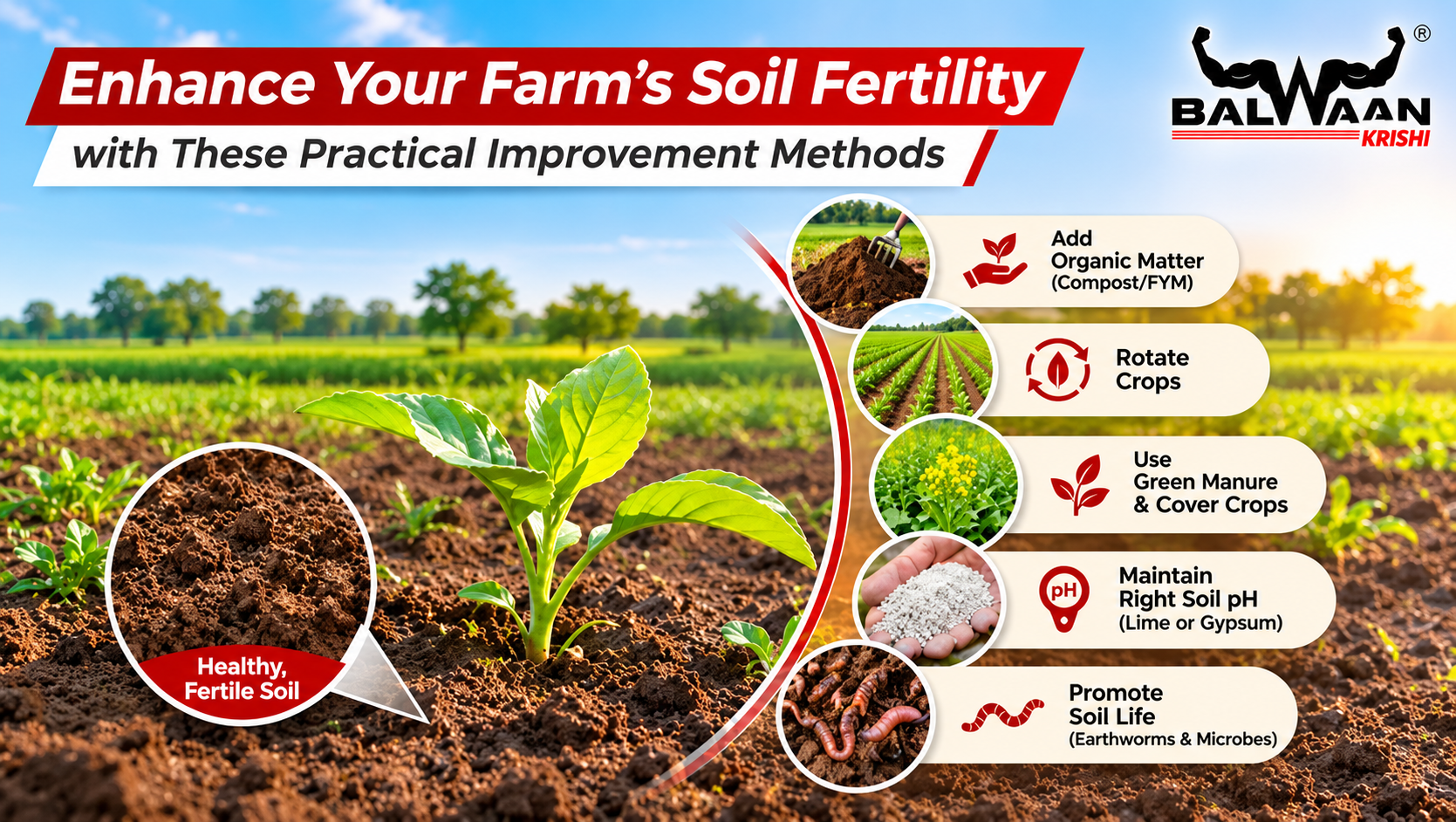
Add organic matter. Compost and farmyard manure feed soil life and help the soil hold water.
Rotate crops. A different crop each season uses different nutrients and breaks the cycle of weeds and pests.
Grow pulses. Bacteria in the roots of pulses and other legumes take nitrogen from the air and leave some of it in the soil.
Plant green manure, a fast-growing crop that is ploughed into the soil while still green.
Apply fertilizer by soil test. Giving only the nutrients that are short avoids waste and imbalance.
Correct soil pH. Lime on acidic soil lets roots take up phosphorus that was locked in the soil.
Till less. Ploughing less often and less deeply protects earthworms and keeps organic matter in the soil.
The first four methods are natural ways to build fertility and are covered together in the next section. Tillage comes after that, followed by fertilizer use and pH correction.
How to Increase Soil Fertility Naturally with Organic Matter
Soil organic matter forms the biological backbone of every productive acre. Knowing how to increase soil fertility naturally starts with feeding soil life using organic residues, which slowly release balanced plant food as they decompose.
Organic matter is the decayed remains of plants and animal dung in the soil, and adding more of it is the main natural way to raise soil fertility. As it breaks down, it releases nutrients slowly through the season, feeds earthworms and soil bacteria, and turns hard soil loose and crumbly.
Compost, Farmyard Manure and Vermicompost
Farmyard manure, compost and vermicompost are the three organic manures most farms can make at home.
1. Farmyard manure (FYM)
FYM comes from cattle dung, urine and shed bedding. Use it only when it is fully rotted, which means dark, crumbly and free of bad smell. Fresh manure can burn young roots and carries weed seeds.
2. Compost
Compost is made by letting farm waste, weeds and vegetable stems rot in a heap or pit with air reaching it.
3. Vermicompost
Earthworms eat farm waste and dung, and their droppings become vermicompost. It is finer and richer in nutrients than ordinary compost.
Spread these inputs evenly three to four weeks before sowing. Working them into the top four to six inches gives beneficial bacteria enough time to stabilize before seeds germinate.
Green Manure and Crop Residues
Green manuring means growing a fast crop such as dhaincha, sunn hemp or cowpea and ploughing it into the soil around flowering, before the stems turn woody. The soft green plants rot quickly and release nitrogen for the next crop.
Crop residue is the straw and stubble left after harvest. Burning it sends most of its carbon and nitrogen into the air as smoke. Ploughing even part of it back into the field returns these nutrients to the soil, and the rest can still be kept for fodder.
Biofertilizers and Soil Microbes
Biofertilizers are packets of live, helpful bacteria that make nutrients in the soil easier for roots to take up. Typical examples of Biofertilizers and Soil Microbes include:
- Rhizobium
Farmers coat pulse seeds with Rhizobium before sowing. The bacteria then live in small lumps on the roots, called nodules, and take nitrogen from the air.
- Azotobacter and Azospirillum
These bacteria live freely in the soil and add nitrogen for non-pulse crops such as wheat, maize and millets.
- Phosphorus solubilising bacteria (PSB)
PSB release mild acids that free phosphorus locked in clay or alkaline soil.
Biofertilizers act as biological supplements rather than complete replacements for manures and mineral fertilizers. Always inspect production expiry dates, shield the open packets from direct sunlight, and ensure that the microbial strain matches your specific crop type.
For precise liquid spray or drench applications of these beneficial microorganisms across seed beds, many farmers rely on a lightweight battery sprayer like the Balwaan SP-50B to ensure uniform coverage without damaging delicate cultures.
Crop Rotation, Legumes and Cover Crops for Soil Fertility
Crop rotation means growing a different crop on the same land each season instead of repeating one crop. When the same crop grows season after season, it takes the same nutrients from the same depth every time, and its weeds and diseases build up in the field.
Rotating crops with different root depths breaks this cycle. For example, a deep-rooted crop such as pigeon pea can follow a shallow-rooted cereal such as wheat and draw nutrients from lower in the soil.
Common crop rotations in India include:
- Kharif rice followed by rabi chickpea or lentil
- Maize followed by Mustard and a summer Mung bean cover crop
- Pearl Millet (Bajra) paired with intercropped Cowpea or Cluster Bean
The pulse in each of these rotations adds nitrogen back to the soil for the next cereal.
Tillage and Soil Preparation: Where Farm Equipment Fits In
Tillage is the mechanical preparation of soil by ploughing or digging the soil before sowing, and how much you till changes how much air, water, and organic matter the soil keeps. Too much ploughing breaks soil crumbs into dust and burns up organic matter faster. It can also press a hard layer, called a hardpan, just below the ploughed depth, which roots and water cannot get through.
The right farm equipment lets you loosen only the topsoil and mix in manure, without disturbing the deeper layers.
Using Mini Tillers and Power Weeders to Prepare Soil
A power weeder is a small walk-behind machine that loosens the topsoil and mixes in manure without the weight of a tractor. On small farms and in orchards, hand hoeing takes many days of labour, and a tractor presses down the soil it drives over. Balwaan Krishi's 7 HP agricultural power weeder, the BP-650, breaks surface crusts and mixes compost into the root zone in the same pass.
The same machine can also make beds and ridges and weed between rows, expanding the power tiller’s uses, all without disturbing deeper subsoil layers.
Fruit trees and windbreak trees need a different kind of soil preparation. Each sapling goes into its own pit filled with a mix of soil and well-rotted manure. The Balwaan 52cc earth auger digs these pits with a 12-inch bit and leaves the soil around each pit undisturbed, unlike digging long trenches.
Reduced Tillage, Mulching and Erosion Control
Reduced tillage means ploughing less often and less deeply, which leaves earthworm burrows and soil crumbs in place. Three other practices protect the topsoil once it has been built up.
- Mulching
Cover bare soil between rows with dry straw, sugarcane trash or grass. The cover keeps the soil cooler in summer, slows drying, and protects the soil life near the surface.
- Controlled irrigation
Flooding a field washes loose topsoil away and carries nutrients below the roots. Furrow and drip irrigation give water in measured amounts instead. A small pump such as Balwaan’s 98cc agricultural water pump lifts water from a well, pond or canal into these channels or pipes.
- Cover in the off-season
Leave stubble standing or sow a cover crop after harvest. Trees planted along the field edge also slow the hot summer winds that blow away dry topsoil.
Balanced Fertilizer Use for Long-Term Soil Fertility Management
Balanced fertilizer use means giving the crop only the nutrients its soil test shows are short, using both manure and chemical fertilizer. This combined approach is called Integrated Nutrient Management (INM).
Following the 4R Nutrient Stewardship framework ensures maximum efficiency while applying fertilizers.
Right source: Choose the fertilizer that supplies the nutrient your soil test shows is short.
Right rate: Apply the amount your Soil Health Card recommends, not a guess.
Right time: Give the fertilizer when the crop needs it most. Nitrogen, for example, works better split into two or three smaller doses than given all at once at sowing.
Right place: Put fertilizer near the roots instead of scattering it over dry soil.
When the soil test shows a micronutrient such as zinc is short, your KVK may advise spraying it on the leaves as a weak solution. A hand-pumped sprayer loses pressure as the operator tires, so some plants get more spray than others. Balwaan’s SP-50B battery sprayer, a 5-litre lithium-ion model, keeps a steady pressure without pumping, which suits small plots and kitchen gardens.
For exact doses, ask your district KVK or agriculture officer, since recommendations differ by region. Applying only what the crop can use also stops extra nitrogen from washing down into the groundwater.
Correcting Acidic Soil with Liming
Acidic soils (pH values dropping well below 6.0) severely restrict how well roots can take up vital elements like phosphorus, calcium, and magnesium, even when those nutrients are present in the ground. In highly acidic soils, aluminum toxicity can also burn tender root tips.
Applying agricultural lime (calcium carbonate) or dolomite neutralizes excess acidity and raises pH back toward a balanced range between 6.0 and 7.0. Before buying or spreading lime, always test your soil to confirm your baseline pH and seek guidance from your local agriculture department on local application rates.
A Simple Seasonal Plan to Keep Soil Fertile
Keeping soil fertile is a yearly cycle of testing, adding manure, careful land preparation, and returning crop waste to the field. The table below shows what to do at each stage of the season:
If you can manage only one step this year, make it the soil test after harvest. Every other step in the table works better once you know which nutrients your field is actually short of.
Common Soil Management Mistakes to Avoid
Three common habits undo the work of building soil fertility.
- Too much urea: Heavy nitrogen without manure gives soft, leafy growth that attracts sucking pests. Over the years, it can also make the soil more acidic.
- Skipping soil tests: Buying fertilizer without a test wastes money on nutrients the soil already has, and the nutrient that is actually short stays short.
- Burning stubble: Fire kills earthworms and soil bacteria near the surface and sends the straw's carbon into the air.
Your nearest Krishi Vigyan Kendra can help you avoid all three. Staff there can test your soil, suggest the right fertilizer dose for your crop, and advise on what to do with stubble instead of burning it.
Frequently Asked Questions
How long does it take to improve soil fertility?
Building visible biological soil fertility typically takes two to three consistent seasons of organic matter additions, green manuring, and balanced fertilizer use. While chemical shortages can be balanced quickly, improving long-term organic carbon and loose crumb structure requires ongoing care.
How often should soil be tested?
Farmland soil should be tested once every two to three years, or whenever you switch cropping patterns. Taking samples at the same point in the crop cycle gives you a dependable view of your progress.
What is the difference between soil fertility and soil health?
Soil fertility focuses primarily on the soil's ability to supply chemical nutrients for crop growth. Soil health is a broader term covering biological activity, physical structure, moisture dynamics, and overall capacity to function as a living ecosystem.
Which crops help improve soil fertility?
Pulses and other legumes improve soil fertility the most, because bacteria in their roots take nitrogen from the air. Moong, urad, cowpea, chickpea and groundnut are common examples. Dhaincha and sunn hemp, grown as green manure, also add a large amount of organic matter when ploughed in.
Does tilling improve or harm soil fertility?
Tilling can both improve and harm soil fertility, depending on how deep and how often you till. Light, shallow tilling loosens the seedbed and mixes manure into the soil. Deep or repeated tilling breaks up soil crumbs, burns up organic matter, destroys earthworm burrows and can form a hardpan below the ploughed layer, so till only as much as your crop needs.