

Weeds pose a constant challenge for Indian farmers and gardeners, choking valuable crops and competing for vital resources. Controlling weeds effectively requires a balanced mix of early action, reliable equipment, and the right techniques. You can manage weeds across fields and gardens by combining five main weed control methods, including preventive, cultural, mechanical, biological, and chemical methods.
This guide details practical techniques, optimal timing, and modern weed removal tools to keep fields clean, productive, and cost-effective throughout the year.
What Are Weeds and Why Weed Management in Agriculture Matters
A weed is simply any plant growing where it is not wanted. In farm fields, orchards, and kitchen gardens, these wild plants grow rapidly and compete directly with your main crop for water, soil nutrients, sunlight, and root space.
Weed management in agriculture matters because these losses add up across a whole season. In its 2018 study, the ICAR-Directorate of Weed Research estimated that weeds cut yields in major Indian field crops by about 25 percent on average. Its newer assessment, based on on-farm trials from 2014 to 2024, put the average loss at about 13 percent. ICAR links this drop to better and more timely weed control on farms.
How Weeds Affect Crop Growth and Farm Costs
Weeds harm the crop directly and also raise the cost of growing it.
- Less water and fertilizer: Weeds use up soil moisture and fertilizer before the crop roots can reach them.
- Less sunlight: Tall broadleaf weeds and wild grasses shade young crop plants. The crop then grows slowly and ripens late.
- More pests and diseases: Many weeds give shelter to insects and plant diseases, which later move onto the crop.
A field with heavy weed growth needs more workers for hand weeding or extra tractor rounds. This spending comes straight out of the money the farmer earns from the harvest.
Annual, Biennial and Perennial Weeds: Know What You’re Fighting
Planning your weed management routine starts with identifying the life cycle of the weeds present. There are usually 3 kinds of weed cycles:
1. Annual Weeds
Annual weeds grow from seed, flower, drop new seed and die within one season. Common examples are bathua (lambsquarters, Chenopodium album), wild mustard, and gulli danda (Phalaris minor) in wheat fields. Because they spread only by seed, removing them before they flower stops the next season's crop of weeds.
2. Biennial Weeds
Biennial weeds live for two seasons. In the first season they grow leaves and a thick root that stores food. In the second season they flower, set seed and die. Common burdock and wild carrot are two examples.
3. Perennial Weeds
Perennial weeds live for more than two years. They grow back every season from deep roots or from underground stems and tubers, so cutting the top alone does not kill them. Motha (purple nutsedge, Cyperus rotundus) and doob grass (Bermuda grass, Cynodon dactylon) are two of the most common perennial weeds on Indian farms.
All three types are easiest to kill as young seedlings. At that stage the roots are shallow and the plants have not yet dropped any seed into the soil.
How to Control Weeds: The 5 Main Weed Control Methods
To control weeds and keep fields clear from sowing to harvest, modern weed management groups all practical field solutions into five core methods:
- Preventive weed control: Stopping weed seeds, tubers, and root parts from entering clean fields.
- Cultural weed control: Managing crop management practices, plant density, and soil cover to suppress weed growth naturally.
- Mechanical weed control: Physically cutting, uprooting, burying, or tilling weeds using manual implements and machinery.
- Biological weed control: Utilizing natural living organisms such as specific insects or grazing livestock to suppress weed populations.
- Chemical weed control: Applying selective or non-selective herbicides to inhibit weed growth or kill unwanted vegetation.
While each method targets weeds differently, preventive and mechanical techniques offer the quickest, chemical-free foundation for maintaining clean beds and healthy field rows.
Preventive and Cultural Weed Control Methods
Preventive and cultural approaches serve as the primary foundation of every sustainable weed control program. Prevention stops weeds before they ever take root, while cultural practices make your fields naturally competitive to unwanted plants.
Preventive Practices to Stop Weeds Before They Start
- Use Certified Clean Seeds
Seed saved at home or bought loose often has weed seeds mixed in. Buy certified seed, which is tested for purity, so you do not sow weeds along with your crop.
- Clean Machinery Between Plots
Wash tillers, harvesters and tractors before moving them from a weedy plot to a clean one. Mud stuck to the blades and wheels can carry weed seeds and pieces of root, including motha tubers.
- Screen Irrigation Water
Canal water and rain runoff carry floating weed seeds into crop furrows. A fine wire mesh fixed across the water inlet catches many of these seeds before they reach the field.
- Manage Field Bunds and Fences
Weeds on bunds and along fences are easy to ignore because they are outside the crop. Cut them before they flower. Otherwise, their seeds blow or wash into the field every season.
Cultural Practices: Crop Rotation, Spacing, Mulching and Cover Crops
Cultural weed control modifies field management practices to give crops a decisive growth advantage over weeds. Adjusting plant competition, soil cover, and field schedules establishes a natural defense across commercial acreage and small farm plots:
- Crop Rotation
When the same crop grows on the same land every season, the weeds that suit that crop increase year after year. Rotating a cereal such as wheat with a pulse changes the sowing date, the root depth and the weeding schedule. This breaks the cycle for those weeds.
- Correct Crop Spacing
Rows spaced too wide leave bare soil open to sunlight for weeks. Sowing at the spacing recommended for your crop lets its leaves cover the ground sooner, and weed seedlings underneath get too little light to grow.
- Organic and Plastic Mulching:
Mulching is the practice of covering the soil between crop rows with a layer of material such as straw, sugarcane trash, or UV-stabilised plastic sheet. The layer blocks light, so most weed seeds under it cannot sprout. Organic mulch works only when it is thick enough to cover the soil completely.
- Cover Crops
A cover crop is a fast-growing crop sown between two main crops so the land does not stay bare. Cowpea, dhaincha and sunn hemp are common choices in India. They crowd out weeds, and because they are legumes, they also add nitrogen to the soil when ploughed in.
Mechanical Weed Control and Weed Removal Tools
Mechanical weed control relies on tools, implements, and motorized equipment to cut, bury, or completely uproot weeds. It remains the most widely practiced approach for farmers seeking fast, chemical-free weed control between planting beds and standing rows.
Hand Weeding Tools for Small Plots and Gardens
Hand weeding tools work without an engine and suit kitchen gardens, nurseries, raised beds and the small gaps between plants where a machine would damage the crop. Farmers usually pick one of three manual weed removal tools based on the soil and how close the weeds are to the crop.
- Khurpi
In nursery beds and vegetable rows, weeds often sprout right next to crop stems where machines cannot reach without harming the plant. A sharp, flat khurpi cuts taproots cleanly under the soil, removing the weed without disturbing the crop's shallow roots.
- Hand Hoe
Hard, dry topsoil traps emerging weeds and blocks water from soaking in, while tiny weed seedlings cover the surface. A short- or long-handled hand hoe scrapes the top layer of dirt, cutting young weed roots and loosening the soil so crop roots can breathe.
- Multi-Tine Hand Weeder
Thin grass roots grip tightly in hard soil, making them hard to pull by hand without snapping the stems. A multi-tine hand weeder digs into the topsoil to loosen the dirt, letting you pull out entire root clumps so the grass does not grow back.
For multi-purpose plot maintenance, Balwaan’s 7-in-1 garden tool supplies swappable heads for raking, trenching, and weeding confined vegetable plots.
Power Weeders and Mini Tillers for Larger Fields
Power weeders and mini tillers are engine-driven machines with rotating blades that cut and bury weeds between crop rows and loosen the topsoil. They suit row crops, orchards and larger fields where hand weeding takes too long.
Farmers usually buy a power weeder for one of three reasons.
- Labour Shortages in Commercial Rows
Weeding a large sugarcane, cotton or maize field by hand needs many workers at once, and workers are hardest to find in the busy weeding weeks. One person with a power weeder covers far more ground in a day than a team weeding by hand.
- Hardpan and Heavy Clay Soils
Hardpan is a hard, packed layer of soil that light hand tools cannot break through. A diesel power weeder like the Balwaan BP-880E has the strength to break these clods and pull out deep roots such as motha tubers. It also loosens the packed soil between wide rows, so water soaks in better.
- Narrow Beds and Protected Structures
Full-sized tractors cannot enter polyhouses or narrow vegetable rows without damaging crop stems. A compact mini power tiller provides tight steering clearance, loosening soil close to plant beds without damaging roots.
Brush Cutters for Bunds, Borders and Fallow Land
Brush cutters are handheld or backpack machines with a spinning blade or nylon line that cuts tall grass, bushes and woody weeds. They work on bunds, ditch banks, fence lines and fallow land, where a tiller or tractor cannot go safely.
Using an electric brush cutter or petrol cutter allows farmers to trim dense overgrowth quickly, eliminating pest shelters and preventing tough perennial weeds from growing onto farmland. Always mow these boundary areas before weeds flower and set seed, as cutting mature plants scatters seeds across bunds and blows them directly into clean crop rows.
How to Choose the Right Weed Removal Tool
The right weed removal tool depends on your field size, row spacing, the type of weeds and how many workers you have. The table below compares the main types of tools on these points.
Biological and Natural Weed Control Methods
Biological weed control uses living insects or animals to keep weeds down to a level the crop can live with. Farmers in India mainly use two approaches.
- Insects and Pathogens
Some weeds came to India from other countries and have no local insects that feed on them, so they spread fast across wasteland and field edges. Parthenium, also called congress grass (Parthenium hysterophorus), is the best-known example. The Mexican beetle (Zygogramma bicolorata) eats the leaves of parthenium plants but does not feed on farm crops, so it is released to bring this weed under control.
- Controlled Grazing
Grazing sheep, goats, or geese in established orchards and plantations cleans out ground weeds naturally while providing organic manure.
Biological control is slow. Insects and animals take time to reduce a weed patch, and each method works only on certain weeds, so it cannot replace weeding during the crop's early weeks.
Chemical Weed Control: Types, Timing and Safe Application
Chemical weed control means spraying herbicides, which are chemicals that kill weeds or stop them from growing. Herbicides can clear a large area quickly and at low cost, but the wrong product, dose or timing can damage the crop and the soil.
Pre-Emergence vs Post-Emergence Herbicides
Herbicides are grouped by when you spray them, before or after the weeds come up.
- Pre-Emergence Herbicides
Pre-emergence herbicides are sprayed on the soil before weed seeds sprout, usually right after sowing. They form a thin chemical layer in the topsoil that kills young weed shoots as they start to grow.
- Post-Emergence Herbicides
Post-emergence herbicides are sprayed on the leaves of weeds that have already come up. They work best while the weeds are young and have only a few leaves. Older weeds develop thick, waxy leaves and tough stems that the spray cannot get through easily.
Selective vs Non-Selective Herbicides
- Selective Herbicides
A selective herbicide kills only certain types of weeds and leaves the crop unharmed when used at the dose on the label. For example, some herbicides kill only grass weeds, so farmers use them in soybean or pulse fields.
- Non-Selective Herbicides
A non-selective herbicide kills or badly damages almost every plant it touches, including the crop. Farmers use these only on fallow land and bunds, or for spot spraying with a shield that keeps the spray off the crop. Some non-selective herbicides are restricted in India or approved only for certain uses, so always check the label and the current rules before buying one.
Safe Herbicide Application with Sprayers
To prevent crop injury, environmental drift, and ineffective weed kill, keep these application guidelines in mind:
- Calibrate the sprayer with plain water first. Check the nozzles, the pressure and your walking speed so the same amount of spray falls on every part of the field.
- Use the right nozzle. Flat-fan or flood-jet nozzles give the even, overlapping spray that herbicides need.
- Watch the weather since wind carries spray onto nearby crops, and rain soon after spraying washes the herbicide off the weed leaves. Spray only on calm, dry days.
- Wear protective gear like waterproof gloves, goggles, boots and a face mask to protect you while mixing and spraying.
- Consistent tank pressure ensures uniform droplet size. A consistent battery sprayer like the Balwaan SP-50B delivers steady pressure without manual pumping, ensuring uniform chemical delivery across every row.
Before using any herbicide, ask your local Krishi Vigyan Kendra or agriculture officer which products are approved for your crop and soil, and at what dose.
Best Time to Control Weeds Through the Crop Cycle
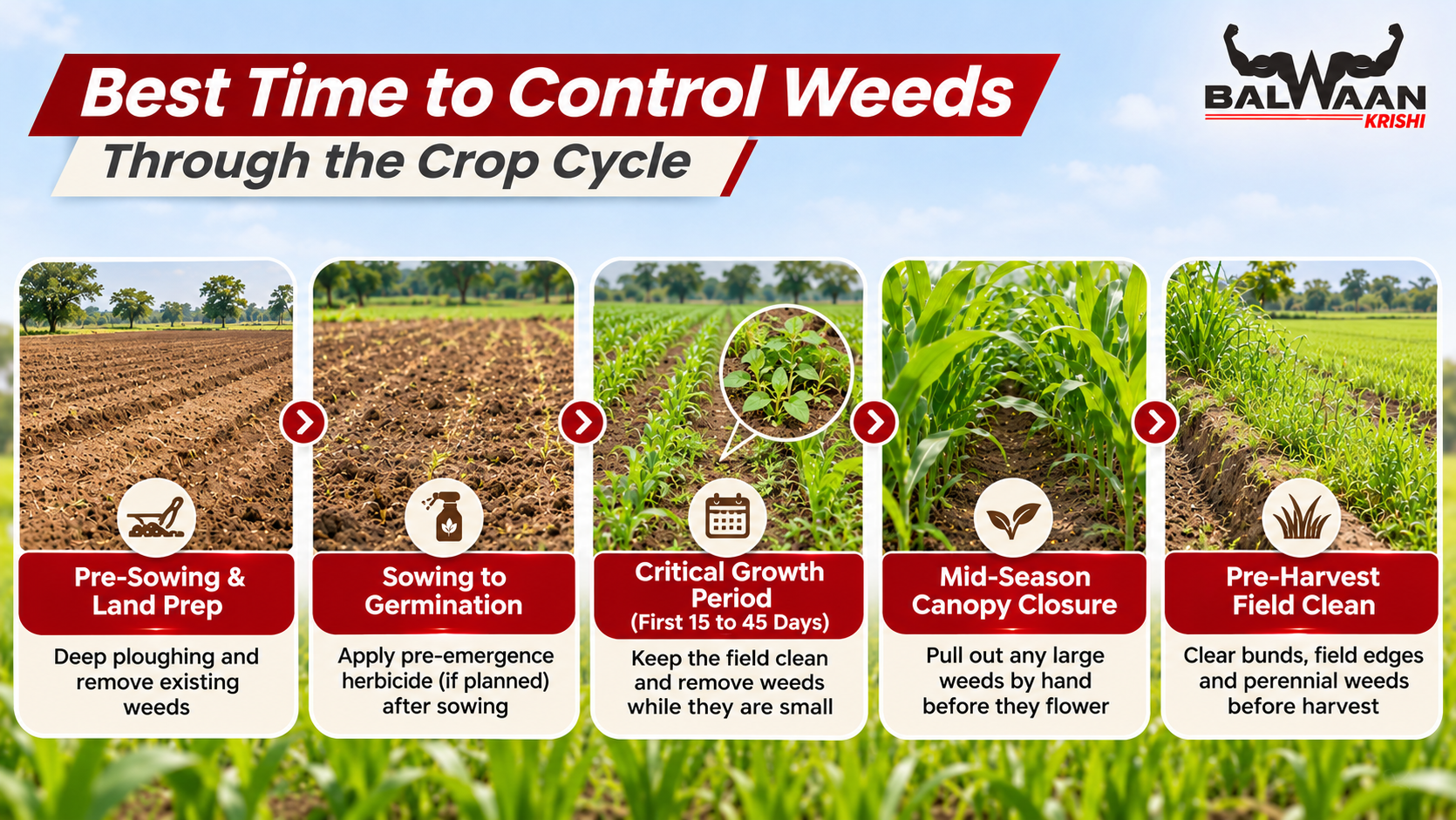 The best time to control weeds is while they are still small, because older weeds take more water and have deep roots that resist pulling and spraying. Follow this field routine across the crop cycle:
- Pre-Sowing & Land Prep: Deep ploughing in summer brings weed roots, underground stems and seeds to the surface, where the hot sun dries them out. Remove any weeds still standing before you sow.
- Sowing to Germination: Apply registered pre-emergence herbicides, if planned, immediately after sowing into moist seedbeds to hold back the initial weed flush.
- Critical Growth Period (First 15 to 45 Days): : The first few weeks after the crop comes up matter most. Weeds left to grow in this window cause yield losses that later weeding cannot recover, so keep the field clean with a power weeder or hand tools. The exact length of this period differs by crop, and your local package of practices gives it for your crop.
- Mid-Season Canopy Closure: Once the crop leaves shade the soil, few new weeds can grow. Pull out any large weeds by hand before they flower.
- Pre-Harvest Field Clean: Clear bunds, field edges and patches of perennial weeds before harvesters enter the field. Machines that pass through weeds carrying seed spread that seed across the field for next season.
Common Weed Control Mistakes to Avoid
Even with good farm equipment, a few common mistakes can undo a season of weed control, and each one has a simple fix.
- Delaying First Weeding
Large weeds with deep roots are hard to pull out, and pulling them often tears the crop roots too. Do the first weeding while the weeds are small seedlings with only a few leaves.
- Mowing Weeds After Seed Formation
Cutting weeds that already carry ripe seed scatters the seed across the field. Cut, till or mow before the weeds start to flower.
- Over-Relying on a Single Herbicide
Spraying the same herbicide season after season lets some weeds survive it and multiply. Over time, that herbicide stops working on your field. Switch between herbicides from different chemical groups, and add mechanical weeding to the plan.
- Using Uncalibrated Spray Equipment
Worn nozzles and an uneven walking speed leave some patches with too little spray and others with so much that the crop burns. Check the spray pattern and measure how much the sprayer puts out before you fill the tank with herbicide.
- Neglecting Field Bunds and Water Inlets
A clean field next to weedy bunds does not stay clean for long, because seeds blow in with the wind and wash in with irrigation water. Keep the bunds cut and the water inlets screened.
Eliminating these five common errors keeps operational expenses predictable, protects crop health during vulnerable early growth stages, and ensures fields remain clean and manageable across consecutive planting seasons.
Frequently Asked Questions
When is the best time to remove weeds?
The best time to remove weeds is during their early seedling stage, typically within the first 15 to 30 days after crop emergence. Young weeds have shallow root systems and tender foliage, making them easy to uproot with power weeders or hand tools before they compete for crop nutrients or produce seeds.
How often should I weed my field?
Most field crops require two to three thorough weedings during the first 45 days after planting, known as the critical weed-competition period. Once the crop canopy grows dense enough to cast deep shade over the soil, weeding frequency drops noticeably, requiring only occasional spot-removal of rogue weeds.
Is a power weeder better than manual weeding?
Yes, for medium to large field operations, a power weeder is significantly faster and far more economical than manual hand weeding. A power weeder completes inter-row cultivation in a fraction of the time, reduces high farm labour expenses, and aerates the root zone while uprooting stubborn weeds. Manual weeding remains preferable mainly for close plant-to-plant spaces and fragile nursery beds
Is it safe to spray herbicides near crops?
It is safe only if you use a crop-approved selective herbicide or apply non-selective herbicides with a protective spray hood to keep droplets off the main crop. Herbicide spraying must always be carried out on calm, clear days using low pressure to avoid drift injury to surrounding plants.
Can mulching really stop weeds?
Mulching can stop most weeds, but not all of them. Weed seeds under the mulch need light to sprout, and a layer of straw, crop waste or plastic sheet keeps that light out. Perennial weeds such as motha can still push up through a thin layer, so pull these out by hand when they appear. A mulched bed also dries out more slowly after irrigation.